
Trees
Trees are one of the key data structures in algorithms and appear in a wide range of problems.
A tree is a connected, acyclic, undirected graph.
A graph G = (V, E) is called a tree if it satisfies the following properties:
Connected — there is a path between every pair of vertices in the graph.
Acyclic — the graph contains no cycles.
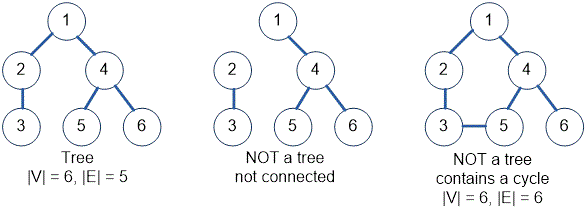
In a tree with vertices, there are always exactly n - 1 edges.
Fundamental Properties of a Tree
1. Connectivity and Uniqueness of Paths
In a tree, there is a unique path between any pair of vertices.
2. Number of Edges
For any tree:
3. No Cycles
Adding even a single edge to a tree always creates a cycle.
4. Root (for a rooted tree)
If one vertex is chosen as the root, the tree becomes directed from the root to its descendants. This is used in recursive traversals and algorithms (, , etc.).
5. Subtrees
Any vertex along with its descendants forms a subtree. A subtree is itself a tree.
6. Leaves
Vertices with zero children (in a rooted tree) are called leaves.
7. Depth and Height
Depth of a vertex is the distance from the root to that vertex.
Height of a tree is the maximum depth among all vertices.
8. Center of a Tree
The center is the vertex (or a pair of adjacent vertices) that minimizes the maximum distance to all other vertices.
Alternative Definitions of a Tree
The following definitions of a tree are equivalent and can be used in different contexts:
A cycle-free graph that becomes disconnected if any edge is removed.
A connected graph with vertices and n - 1 edges.
An acyclic graph with n - 1 edges and exactly one connected component.
Representing Trees in Code
Depending on the problem and the type of tree (general, binary, rooted, etc.), different data structures are used:
1. Adjacency Lists
This approach is often used in competitive programming problems and when working with undirected or directed trees.
int n;
vector<vector<int>> tree(n); // tree with n vertices

// adding an edge between vertices u and v
tree[u].push_back(v);
tree[v].push_back(u); // for an undirected tree
2. Parent Array
A very compact representation, especially useful when the tree is already constructed.
vector<int> parent(n); // parent[i] --- he parent of vertex i
// if i is the root, parent[i] is usually set to -1 or 0
3. Pointers / Structures (OOP Style)
Commonly used when constructing binary trees, tries, decorators, especially in Python/Java/C++ with object-oriented programming.
Binary Tree:
struct Node
{
  int val;
  Node* left;
  Node* right;
  Node(int v) : val(v), left(nullptr), right(nullptr) {}
};General Tree:
struct Node
{
  int val;
  vector<Node*> children;
  Node(int v) : val(v) {}
};
Comments5