
Trees
Trees are one of the key data structures in algorithms and appear in a wide range of problems.
A tree is a connected, acyclic, undirected graph.
A graph G = (V, E) is called a tree if it satisfies the following properties:
Connected — there is a path between every pair of vertices in the graph.
Acyclic — the graph contains no cycles.
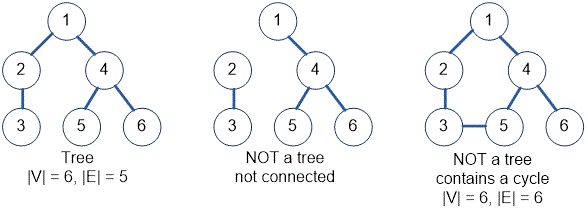
In a tree with n vertices, there are always exactly n - 1 edges.
Fundamental Properties of a Tree
1. Connectivity and Uniqueness of Paths
In a tree, there is a unique path between any pair of vertices.
2. Number of Edges
For any tree:
3. No Cycles
Adding even a single edge to a tree always creates a cycle.
4. Root (for a rooted tree)
If one vertex is chosen as the root, the tree becomes directed from the root to its descendants. This is used in recursive traversals and algorithms (DFS, LCA, etc.).
5. Subtrees
Any vertex along with its descendants forms a subtree. A subtree is itself a tree.
6. Leaves
Vertices with zero children (in a rooted tree) are called leaves.
7. Depth and Height
Depth of a vertex is the distance from the root to that vertex.
Height of a tree is the maximum depth among all vertices.
8. Center of a Tree
The center is the vertex (or a pair of adjacent vertices) that minimizes the maximum distance to all other vertices.
Alternative Definitions of a Tree
The following definitions of a tree are equivalent and can be used in different contexts:
A cycle-free graph that becomes disconnected if any edge is removed.
A connected graph with n vertices and n - 1 edges.
An acyclic graph with n - 1 edges and exactly one connected component.
Representing Trees in Code
Depending on the problem and the type of tree (general, binary, rooted, etc.), different data structures are used:
1. Adjacency Lists
This approach is often used in competitive programming problems and when working with undirected or directed trees.
int n;
vector<vector<int>> tree(n); // tree with n vertices

// adding an edge between vertices u and v
tree[u].push_back(v);
tree[v].push_back(u); // for an undirected tree
2. Parent Array
A very compact representation, especially useful when the tree is already constructed.
vector<int> parent(n); // parent[i] --- he parent of vertex i
// if i is the root, parent[i] is usually set to -1 or 0
3. Pointers / Structures (OOP Style)
Commonly used when constructing binary trees, tries, decorators, especially in Python/Java/C++ with object-oriented programming.
Binary Tree:
struct Node
{
  int val;
  Node* left;
  Node* right;
  Node(int v) : val(v), left(nullptr), right(nullptr) {}
};General Tree:
struct Node
{
  int val;
  vector<Node*> children;
  Node(int v) : val(v) {}
};
Comments5