
Two pointers technique
The Two Pointers technique is a strategy commonly used in computer science and programming for solving problems involving arrays or sequences. It involves using two pointers that traverse the array or sequence from different positions, often moving in opposite directions or at different speeds. This technique is particularly useful for solving problems related to searching, optimization, or manipulation of arrays efficiently.
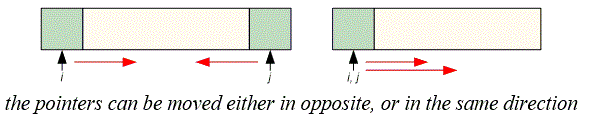
Here's a breakdown of how the Two Pointers technique works:
Initialization: Initially, you set up two pointers, usually at different positions within the array or sequence.
Movement: You iteratively move the pointers based on certain conditions until they meet or reach a specific condition. The movement of pointers can be controlled based on the problem requirements. For example, one pointer might move faster than the other, or they might move in opposite directions.
Condition Checking: At each step of iteration, you check certain conditions based on the problem requirements. These conditions often determine whether to move the pointers, update some variables, or perform other operations.
Termination: The process continues until one or both pointers reach the end of the array or sequence, or until some other termination condition is met.
The Two Pointers technique is especially useful in problems that involve searching for pairs or subarrays that meet specific criteria, finding optimal solutions, or manipulating sequences efficiently without using nested loops. It often provides a more efficient solution compared to brute-force approaches, especially for problems with linear or logarithmic time complexity requirements.
Comments5