Cake from Tolya#1033

Let us represent the cake as a line segment of some length. Mark the cuts corresponding to dividing it into equal parts. Then mark the cuts corresponding to dividing it into equal parts. Making all these cuts will give us exactly the required partition. It remains to count the number of resulting pieces. This number is:
Proof. Dividing the cake into equal parts requires n - 1 cuts. Similarly, dividing it into parts requires m - 1 cuts. Among them, there will be GCD(n, m) - 1 coinciding cuts. Therefore, the total number of distinct cuts is
After making these cuts, the cake will be divided into n + m - GCD(n, m) pieces.
Example
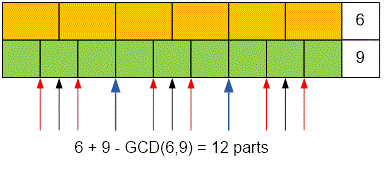
When cutting the cake into pieces, cuts are required.
When cutting the cake into pieces, cuts are required.
Among them, GCD(6, 9) - 1 = 2 cuts coincide.
Thus, the cake will have 5 + 8 - 2 = 11 distinct cuts. After making them, the cake will be divided into pieces.
Algorithm implementation
The function gcd computes the greatest common divisor of the numbers and .
int gcd(int a, int b)
{
  return (!b) ? a : gcd(b,a % b);
}
The main part of the program. Read the input data.
scanf("%d %d",&m,&n);Compute and print the answer.
res = m + n - gcd(m,n);
printf("%d\n",res);
Java implementation
import java.util.*;

public class Main
{

  static int gcd(int a, int b)
  {
    return (b == 0) ? a : gcd(b,a % b);
  }

  public static void main(String []args)
  {
    Scanner con = new Scanner(System.in);
    int m = con.nextInt();
    int n = con.nextInt();

    int res = m + n - gcd(m,n);
    System.out.println(res);
    con.close();
  }
} Python implementation
The function gcd computes the greatest common divisor of the numbers and .
def gcd(a, b):
  if a == 0: return b
  if b == 0: return a
  if a > b: return gcd(a % b, b)
  return gcd(a, b % a)
The main part of the program. Read the input data.
m, n = map(int, input().split())Compute and print the answer.
res = m + n - gcd(m, n)
print(res)