Diamond Collector (Bronze)#10568

Sort the array of diamond sizes. For each index , consider the sequence m_i, m_{i+1}, ..., m_j such that | m_j - m_i | \le k, but at the same time, | m_{j+1} - m_i | > k. Among all such sequences, find the one that contains the largest number of elements.
Example
Sort the sizes of the diamonds.
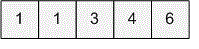
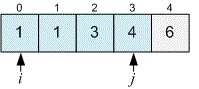
Consider the interval . The difference between the sizes of the diamonds in this interval does not exceed k = 3. However, Bessie will not be able to showcase all the diamonds in the interval in the barn, since m_4 - m_0 > 3.
Algorithm realization
Declare an array to store the sizes of the diamonds.
int m[1000];Read the input data.
scanf("%d %d", &n, &k);
for (i = 0; i < n; i++)
  scanf("%d", &m[i]);
Sort the array.
sort(m, m + n);The maximum number of diamonds that Bessie can display in the barn is counted in the variable .
res = 0;For each index , consider the sequence m_i, m_{i+1}, ..., m_j of the greatest length such that | m_j - m_i | \le k. Count the length of this sequence in the variable .
for (i = 0; i < n; i++)
{
  cnt = 0;
  for (j = i; j < n; j++)
  {
As soon as the condition | m_j - m_i | > k becomes true, exit the loop.
    if (m[j] > m[i] + k) break;
    cnt++;
  }
Among the lengths of all sequences, find the maximum.
  if (cnt > res) res = cnt;
}
Print the answer.
printf("%d\n", res);