Avengers#10648

According to the problem statement, it is impossible to return to the starting city after traveling along several roads, so the road graph is a directed acyclic graph.
The task is to find three distinct vertices such that no path passes through all of them, or to report that no such vertices exist.
If n < 3, it is impossible to choose three distinct cities, and the answer is . From now on, we assume that n \ge 3.
Any path in an acyclic graph visits vertices in the order of their topological sort. Therefore, if a path contains vertices and , then one of them is reachable from the other. This leads to the key observation: if there exist two vertices and such that neither is reachable from the other, then no path passes through both of them. Consequently, there is no path through the triple x, y, z either, where is an arbitrary third vertex.
Such a pair of vertices can be conveniently found using Kahn's topological sorting algorithm. Initially, all vertices with zero in-degree are placed into the queue. Then vertices are extracted from the queue one by one and removed from the graph together with their outgoing edges; vertices whose in-degree becomes zero as a result are added to the queue.
Statement 1. If at some moment the queue simultaneously contains two vertices and , then there is no path between them.
Statement 2. If at every step of the algorithm the queue contains exactly one vertex, then all vertices of the graph lie on a single path.
Thus, the algorithm is as follows: run Kahn's algorithm and check the size of the queue before each extraction. As soon as it contains more than one vertex, take any two of them as and , and any other vertex of the graph as . If this moment never occurs, print .
Each vertex and each edge is processed at most once, so the time complexity of the algorithm is O(n + m), and the memory usage is O(n + m).
Example
The graphs from the sample tests have the following structure:
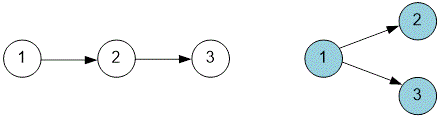
In the first example, the queue contains a single vertex at every step: \{1\}, \{2\}, \{3\}. The graph contains the path 1 \to 2 \to 3 passing through all vertices, so the answer is .
In the second example, the queue initially contains vertex . After it is removed, the in-degrees of vertices and become zero, and both of them appear in the queue simultaneously. There is no path between vertices and , so we can take x = 2, y = 3 and z = 1 as the answer.
Algorithm implementation
Declare the data structures. The input graph is represented by the adjacency list , and the in-degrees of the vertices are stored in the array InDegree.
vector<vector<int> > g;
vector<int> InDegree;
deque<int> q;
Read the input data.
scanf("%d %d", &n, &m);
g.resize(n + 1);
InDegree.resize(n + 1);
for (i = 0; i < m; i++)
{
  scanf("%d %d", &a, &b);
g[a].push_back(b);For each edge , increment InDegree[b] by .
  InDegree[b]++;
}
All vertices with an in-degree of zero are added to the queue .
for (i = 1; i < InDegree.size(); i++)
  if (InDegree[i] == 0) q.push_back(i);
The three desired vertices are stored in the variables and .
x = y = -1;Continue executing the algorithm as long as the queue is not empty.
while (!q.empty())
{
If the queue contains more than one vertex at the same time, this means that the solution has been found.
  if (q.size() > 1)
  {
    x = q[0];
    y = q[1];
    break;
  }
Extract the vertex from the queue — it will become the current vertex in the topological order.
v = q.front(); q.pop_front();Remove from the graph all edges of the form (v, to). For each such edge, decrease the in-degree of the vertex . If the in-degree of becomes zero, add it to the queue.
  for (int to : g[v])
  {
    InDegree[to]--;
    if (InDegree[to] == 0) q.push_back(to);
  }
}
Kahn's algorithm is complete. If the value of is still , this means that no solution exists.
if (x == -1)
  printf("-1\n");
else
{
If a solution exists, choose as the smallest vertex different from and .
  z = 1;
  while (z == x || z == y) z++;
    printf("%d %d %d\n", x, y, z);
}