XOR Sum#10653

Using depth-first search, compute the XOR sum between vertex and all other vertices. Store the XOR sum between vertex and in . Let be the number of ones and be the number of zeros in the array x~(ones + zeroes = n). Then the answer to the problem will be ones \cdot zeroes.
Example
Consider the graph provided in the example.
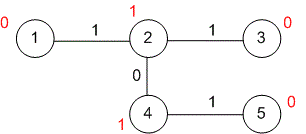
Next to each vertex , the XOR sum between and is written. If x[v] = x[u] for some vertices and , then the XOR sum between them is equal to , thus contributing to the total sum. The XOR sum for each pair of vertices , for which x[v] \ne x[u], contributes to the total sum.
Therefore, the answer is equal to the number of pairs of vertices for which x[v] \ne x[u]. This number is equal to ones \cdot zeroes = 2 \cdot 3 = 6. The pairs of vertices that contribute to the total sum are: (1, 2), (1, 4), (2, 3), (2, 5), (3, 4), (4, 5).
Algorithm implementation
Store the input graph in the adjacency list . Declare an array .
vector<vector<pair<int,int> > > g;
vector<int> x;
The dfs function implements a depth-first search that computes the XOR sum between vertices and . The current XOR sum between and is represented by cur\_xor. The parent of vertex is .
void dfs(int v, int cur_xor, int p = -1)
{
  x[v] = cur_xor;
  for (auto z : g[v])
  {
    int to = z.first;
    int w = z.second;
    if (to != p) dfs(to, cur_xor ^ w, v);
  }
}The main part of the program. Read the input graph.
scanf("%d", &n);
g.resize(n + 1);
x.resize(n + 1);

for (i = 1; i < n; i++)
{
  scanf("%d %d %d", &u, &v, &d);
  g[u].push_back({v, d});
  g[v].push_back({u, d});
}Start the depth-first search from vertex .
dfs(1, 0, -1);Compute the number of and in the array .
ones = 0;
for (i = 1; i <= n; i++)
  if (x[i] == 1) ones++;
zeroes = n - ones;
Print the answer.
printf("%lld\n", 1LL * ones * zeroes);Python implementation
The dfs function implements a depth-first search that computes the XOR sum between vertices and . The current XOR sum between and is represented by cur\_xor. The parent of vertex is .
def dfs(v, cur_xor = 0, p = -1):
  x[v] = cur_xor
  for to, w in g[v]:
    if to != p:
      dfs(to, cur_xor ^ w, v)
The main part of the program. Read the input graph.
n = int(input())
g = [[] for _ in range(n + 1)]
for _ in range(n - 1):
  u, v, d = map(int, input().split())
  g[u].append((v, d))
  g[v].append((u, d))
Initialize the list .
x = [0] * (n + 1)Start the depth-first search from vertex .
dfs(1)Compute the number of and in the array .
ones = sum(x)
zeroes = n - ones
Print the answer.
print(ones * zeroes)