Fill the line#1070

Store the endpoints of the segments in an array , keeping track of whether each point is a left or right endpoint. Then sort the 2 \cdot n points by their -coordinate . Next, move from left to right through the intervals (v[i], v[i + 1]) between the points, simulating a sweep line.
Maintain a variable , which represents the number of segments covering the interval (v[i], v[i + 1]). Initially, is set to . Increase by when encountering a point that is the start of a segment and decrease it by when encountering a point that is the end of a segment.
The total length of the painted portion of the line is the sum of the lengths of intervals x_{i+1} - x_i, where depth \ne 0.
Example
Let us consider the set of the following segments:
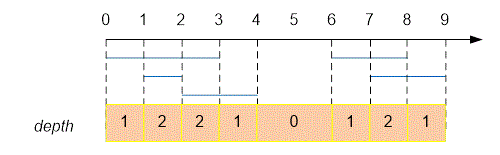
The answer is the sum of the lengths of the intervals x_{i+1} - x_i, where depth \ne 0.
Algorithm implementation
The endpoints of the segments will be stored in an array as pairs: (-coordinate of the point, label indicating whether it is the start or end of a segment).
vector<pair<int, int> > v; // (x, flag), flag: 0 = Left, 1 = RightRead the segments and form an array of points.
scanf("%d", &n);
for (i = 0; i < n; i++)
{
  scanf("%d %d", &Left, &Right);
  v.push_back({Left, 0}); // start of a segment
  v.push_back({Right, 1}); // end of a segment
}Sort the points by their -coordinate.
sort(v.begin(), v.end());Maintain the depth of overlap (the number of segments covering the current interval) in the variable.
depth = 0;The length of the painted portion of the line is computed in the variable .
res = 0;Move through the points from left to right. For each value of , consider the interval [v[i].first, v[i + 1].first].
If the point is the start of a segment, increase the by .
If the point is the end of a segment, decrease the by .
If depth > 0 on the current interval, the interval is considered painted, and its length is added to .
Since array contains 2 \cdot n points, the loop will iterate over 2 \cdot n - 1 intervals.
for (i = 0; i < v.size() - 1; i++)
{
  if (v[i].second == 0) depth++; else depth--;
  if (depth > 0) res += v[i + 1].first - v[i].first;
}
Print the answer.
printf("%d\n", res);Algorithm implementation — class
Declare a class , which stores the -coordinate of the point and a label (which indicates whether the point is the start or the end of a segment).
class Point
{
public:
  int x;
  char c; // 'b' – начало отрезка, 'e' – конец отрезка
  Point(void)
  {
    x = 0; c = '-';
  }
  Point(int x, char c) : x(x), c(c) {};
};

Point p[MAX];The function f is a comparator for sorting the points by their -coordinate.
int f(Point a, Point b)
{
  return a.x < b.x;
}
The main part of the program. Read the segments. Construct an array of points.
scanf("%d",&n);
for(i = 0; i < 2 * n; i += 2)
{
  scanf("%d %d",&x,&y);
  p[i] = Point(x,'b');
  p[i+1] = Point(y,'e');
}Sort the points by their -coordinate.
sort(p, p + 2 * n, f);Simulate the movement of the sweep line from left to right.
depth = len = 0;
for(i = 0; i < 2 * n - 1; i++) // двигаемся по отрезку [p[i]...p[i+1]
{
  if (p[i].c == 'b') depth++;
  if (p[i].c == 'e') depth--;
  if (depth > 0) len += p[i+1].x - p[i].x;
}Print the answer.
printf("%d\n",len);