Squares and Cubes#10995

Generate all perfect squares and cubes of positive integers from to 10^9 and store them in a set . Duplicate values will be automatically eliminated, since a set does not allow duplicates. Then, copy the elements of the set into an array , which will be sorted in ascending order because is an ordered set.
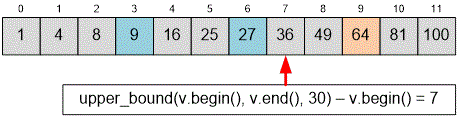
Next, for each input number , use binary search to determine how many squares and cubes do not exceed . To do this, we use an upper bound search (upper\_bound) — it returns the position of the first element in array that is strictly greater than . This position is the answer to the query, as it corresponds to the number of qualifying values.
Example
Let's generate all perfect squares and cubes of numbers from to (inclusive).

Now process the query for n = 30. In this case, the resulting position is pos = 7, meaning there are exactly such numbers in the interval from to .
Note that indexing in the array starts from zero.
Algorithm implementation
Generate all perfect squares and cubes of positive integers from to 10^9 and store them in a set . If a number is both a perfect square and a perfect cube (for example, ), it will be added to the set only once, since sets automatically eliminate duplicates.
for (i = 1; i * i <= 1000000000; i++)
  s.insert(i * i);
for (i = 1; i * i * i <= 1000000000; i++)
  s.insert(i * i * i);
Then, transfer the elements of the set into an array . Because the set is ordered, the array will also be sorted in ascending order.
v = vector<int>(s.begin(), s.end());Process the given number of tests sequentially.
scanf("%d", &tests);
while (tests--)
{
  scanf("%d", &n);
Using binary search with an upper bound, find the smallest index such that all perfect squares and cubes of positive integers not exceeding are located in the array at positions from to pos - 1. Thus, the number of listed numbers from to equals .
  res = upper_bound(v.begin(), v.end(), n) - v.begin();
  printf("%d\n", res);
}