Breed Counting#11159

Let's declare three integer arrays s[i]~(1 \le i \le 3). The prefix sums for cows of breed will be stored in the array .
The answer to the query is computed as follows:
The number of cows of breed is s[1][b] - s[1][a - 1];
The number of cows of breed is s[2][b] - s[2][a - 1];
The number of cows of breed is s[3][b] - s[3][a - 1];
Example
For the given example, the prefix sum arrays s[i]~(1 \le i \le 3) will be as follows:
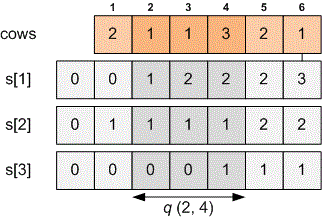
Consider the query on the interval :
The number of cows of breed is s[1][4] - s[1][1] = 2 - 0 = 2;
The number of cows of breed is s[2][4] - s[2][1] = 1 - 1 = 0;
The number of cows of breed is s[3][4] - s[3][1] = 1 - 0 = 1;
Algorithm implementation
Declare an array for storing prefix sums.
#define MAX 100001
int s[4][MAX];
Read the input data.
scanf("%d %d", &n, &q);Compute the prefix sum arrays.
memset(s, 0, sizeof(s));
for (i = 1; i <= n; i++)
{
  scanf("%d", &x);
  for (j = 1; j <= 3; j++)
    s[j][i] = s[j][i - 1];
  s[x][i]++;
}Process the queries sequentially.
for (i = 0; i < q; i++)
{
   scanf("%d %d", &a, &b);
   printf("%d %d %d\n", s[1][b] - s[1][a - 1], s[2][b] - s[2][a - 1],
                        s[3][b] - s[3][a - 1]);
}
Python implementation
import sysRead the input data.
n, q = map(int, input().split())Declare a list for storing prefix sums.
s = [[0] * (n + 1) for _ in range(4)]Compute the prefix sum arrays.
for i in range(1, n + 1):
  x = int(input())
  for j in range(1, 4):
    s[j][i] = s[j][i - 1]
  s[x][i] += 1
Process the queries sequentially.
for _ in range(q):
  a, b = map(int, input().split())
  print(s[1][b] - s[1][a - 1], s[2][b] - s[2][a - 1],
        s[3][b] - s[3][a - 1])