Palindrome Partitioning#11245

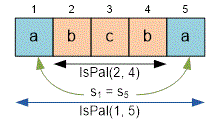
Let be the input string. The substring s_i~...~s_j is a palindrome if one of the following conditions is satisfied:
i \ge j (the substring is empty or consists of a single character);
s_i = s_j and the substring s_{i+1}~...~s_{j-1} is a palindrome;
Let the function IsPal(i, j) return if s_i ... s_j is a palindrome, and otherwise. The values of IsPal(i, j) are stored in the cells pal[i][j].
Let the function f(i, j) return the minimum number of cuts required to partition the substring s_i~...~s_j into palindromes. The values of this function will be stored in the cells of the array dp[i][j]. Therefore, the solution to the problem will be f(0, s.size() - 1).
Note that f(i, i) = 0, as a string consisting of a single character is already a palindrome.
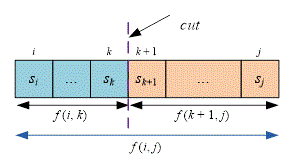
To compute f(i, j), cut the substring s_i~...~s_j into two parts: s_i~...~s_k and s_{k+1}~...~s_j~(i \le k < j). Recursively solve the problems on the strings s_i~...~s_k and s_{k+1}~...~s_j. Look for the value of k~(i \le k < j) that minimizes the sum f(i, k) + f(k + 1, j) + 1. The term in the sum represents the single cut made between the characters s_k and s_{k+1}. Thus, we obtain the following recurrence relation:
Example
For example, for the string "" consisting of characters, we have:
The sum takes its minimum value at k = 3:
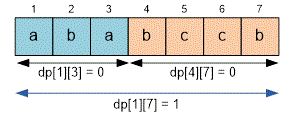
Since the substrings "" and "" are palindromes, f(1, 3) = f(4, 7) = 0.
Algorithm implementation
Define the constants, the input string , and the arrays.
#define MAX 1001
#define INF 0x3F3F3F3F
int dp[MAX][MAX], pal[MAX][MAX];
string s;
The function IsPal(i, j) checks whether the substring s_i~...~s_j is a palindrome. The substring s_i~...~s_j is a palindrome if s_i = s_j and s_{i+1}~...~s_{j-1} is a palindrome. The values of IsPal(i, j) are stored in the cells of the array pal[i][j].
int IsPal(int i, int j)
{
  if (i >= j) return pal[i][j] = 1;
  if (pal[i][j] != -1) return pal[i][j];
  return pal[i][j] = (s[i] == s[j]) && IsPal(i + 1, j - 1);
}
The function f(i, j) returns the minimum number of cuts required to partition the substring s_i~...~s_j into palindromes.
int f(int i, int j)
{
If i = j, the substring s_i~...~s_j consists of a single character, and no cuts are needed. If i > j, the substring s_i~...~s_j is considered empty, and no cuts are required.
if (i >= j) return 0;If the value f(i, j) is already computed, return the stored value from the dp[i][j].
if (dp[i][j] != INF) return dp[i][j];If the substring s_i~...~s_j~(i < j) is a palindrome, there is no need to make any cuts. In this case, the minimum number of cuts is .
if (IsPal(i, j)) return dp[i][j] = 0;Cut the substring s_i~...~s_j into two parts: s_i~...~s_k~(i \le k) and s_{k+1}~...~s_j~(k + 1 \le j). Then, recursively solve the problems for both parts: s_i~...~s_k and s_{k+1}~...~s_j. Find the value of k~(i \le k < j) for which the sum f(i, k) + f(k + 1, j) + 1 is minimized.
  for (int k = i; k < j; k++)
    dp[i][j] = min(dp[i][j], f(i, k) + f(k + 1, j) + 1);
Return the answer dp[i][j] = f(i, j).
  return dp[i][j];
}
The main part of the program. Read the input string.
cin >> s;Initialize the arrays.
memset(dp, 0x3F, sizeof(dp));
memset(pal, -1, sizeof(pal));
Compute and print the answer.
res = f(0, s.size() - 1);
cout << res << endl;