Lemurian parties - easy#11269

For seats, some species will be represented by two lemurs, and some by one. Let pairs of lemurs be chosen (that is, species are represented by two individuals). The number of ways to make such a choice is C_k^i. After this, there will be n - 2i free seats in the VIP area. These seats can be occupied by lemurs from k - i remaining species, choosing one lemur from each. The number of ways to choose such lemurs is calculated by the formula C_{k - i}^{n - 2i}.
Since the value of can take any integer from to , the final answer is obtained as the sum over all possible values of :
Example
Let's consider a second example, where there are k = 4 pairs of lemurs and n = 3 seats in the VIP area. Using the formula, we get:
Let's list only the nonzero terms. We'll consider the value C_n^k to be zero if any of the following three inequalities hold: k < 0, n < 0 или k > n.
Let us denote the lemurs by the letters \{a, a, b, b, c, c, d, d\}, where identical letters correspond to lemurs of the same species.
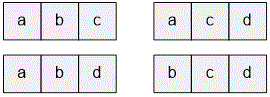
The term C_4^0 \cdot C_4^3 = 4 corresponds to the situation where no pair of lemurs of the same species is chosen, that is, each of the three selected lemurs belongs to a different species. The four possible selections are as follows:
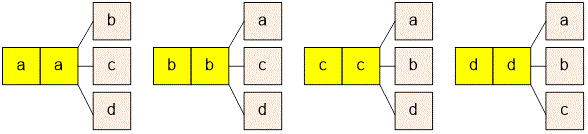
Now consider the term C_4^1 \cdot C_3^1 = 12. In this case, two lemurs are chosen from one species (there are possible ways to do this). For the remaining one seat, one lemur is chosen from the three remaining species. Thus, there are a total of possible selections.
It is clear that it is impossible to place two lemurs from two different species in only seats. Therefore, all the remaining terms of the sum are equal to zero.
Algorithm implementation
Declare the constants.
#define MAX 1000001
#define MOD 1000000007
Let us define the following arrays:
contains the factorials of numbers modulo ;
factinv contains the values inverse to the factorials of numbers modulo :
fact[n] = n! mod 1000000007
factinv[n] = n! -1 mod 1000000007

typedef long long ll;
ll fact[MAX], factinv[MAX];
The function pow computes the power of a number modulo : x^n~mod~p.
ll pow(ll x, ll n, ll p)
{
  if (n == 0) return 1;
  if (n % 2 == 0) return pow((x * x) % p, n / 2, p);
  return (x * pow(x, n - 1, p)) % p;
}
The function inverse finds the number that is the modular inverse of with respect to a prime modulo . Since is a prime number, by Fermat's little theorem the following equality holds:
This equality can be rewritten as:
which means that the modular inverse of is x^{p-2}~mod~p.
ll inverse(ll x, ll p)
{
  return pow(x, p - 2, p);
}
The function Cnk computes the value of the binomial coefficient using the following formula:
ll Cnk(int n, int k)
{
  return ((fact[n] * factinv[k]) % MOD * factinv[n - k]) % MOD;
}
The main part of the program. Read the input data.
scanf("%d %d", &k, &n);Fill the factorial arrays and factinv.
fact[0] = 1;
for (i = 1; i < MAX; i++)
  fact[i] = (fact[i - 1] * i) % MOD;

factinv[0] = 1;
for (i = 1; i < MAX; i++)
factinv[i] = inverse(fact[i], MOD);Compute the answer using the formula \sum_{i = 0}^k C_k^i \cdot C_{k - i}^{n - 2i}. The value of the binomial coefficient C_n^k is considered to be zero if any of the following three conditions hold: k < 0, n < 0 or k > n.
res = 0;
for (i = 0; i <= k; i++)
{
  if (n - 2 * i < 0 || k - i < 0 || n - 2 * i > k - i) continue;
  res = (res + Cnk(k, i) * Cnk(k - i, n - 2 * i)) % MOD;
}
Print the answer.
printf("%lld\n", res);