Longge`s problem#1128

Theorem. If the function is multiplicative, then the summatory function
is also multiplicative.
Proof. Let x, y \in N, where and are coprime.
Let x_1, x_2, ..., x_k be all divisors of , and let y_1, y_2, ..., y_m be all divisors of .
Since and are coprime, any divisor x_i is coprime to any divisor y_j. Therefore, GCD(x_i, y_j) = 1. This means that the product x_i \cdot y_j is a divisor of the number x \cdot y.
Moreover, each product x_i \cdot y_j gives a distinct divisor of x \cdot y, and in this way we obtain all divisors of x \cdot y. Therefore, the sum over all divisors of x \cdot y can be represented as a double sum over all pairs of divisors x_i and y_j. Then
Corollary. Consider the function f(n) = GCD(n, c), where is a constant. Let us show that this function is multiplicative.
If and are coprime, then
Therefore, the function f(n) = GCD(n, c) is multiplicative.
Example. Let us compute GCD(36, 90) using the multiplicativity property.
Now let us consider its summatory function:
From the previous theorem, we know that the summatory function of a multiplicative function is also multiplicative. Therefore, the function is also multiplicative.
If we factor into powers of prime numbers n = p_1^{a_1} p_2^{a_2}...p_k^{a_k}, then
Lemma. Let be a divisor of . Then there are exactly integers such that 1 \le i \le n and GCD(i, n) = d.
► If GCD(i, n) = d, then divides . Let us represent in the form i = d \cdot j. Since divides , we can write as n = d \cdot (n / d). Then:
We are interested in those values of for which GCD(i, n) = d. Therefore, we must have d \cdot GCD(j, n / d) = d. Hence
The number of integers that are coprime to is .
Example. Consider the number n = 24 and find all integers for which GCD(i, 24) = 3. According to the lemma, the number of such integers is φ(24 / 3) = φ(8) = 4.
To find these integers, let i = 3 \cdot j. Then, from the proof of the lemma, we know that GCD(j, 8) = 1. This equality holds for j \in \{1, 3, 5, 7\}. Therefore, GCD(i, 24) = 3 for i \in \{3, 9, 15, 21\}.
Theorem (formula for the sum of GCDs in terms of Euler’s totient function). Let be a positive integer and
Then
where the sum is taken over all positive divisors of , and is Euler's totient function
Proof. Consider all integers from to and group them according to the value of GCD(i, n).
Let GCD(i, n) = e. According to the lemma above, the number of such integers is exactly . Each such integer contributes the same value to the sum . Therefore, all integers for which GCD(i, n) = e contribute a total of e \cdot φ(n / e).
The value is always a divisor of . Therefore, to obtain the entire sum , we need to sum these contributions over all divisors of :
Let us make a change of variable: d = n / e. Then e = n / d. Since is a divisor of is also a divisor of . Substituting e = n / d into the obtained formula, we get:
Theorem. Let
Then, for any prime and positive integer , the following relation holds:
► For a = 1, we have:
For a = 2, we have:
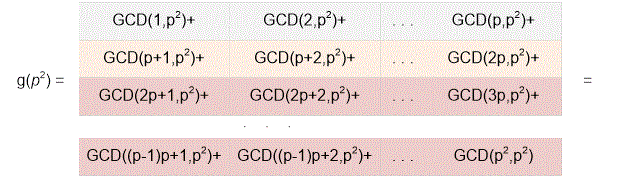
Let us compute g(p^a). The value of GCD(i, p^a) can only be a divisor of p^a. Since is a prime number, all divisors of p^a have the form p^k, where 0 \le k \le a.
Let us find the number of integers from to p^a for which GCD(i, p^a) = p^k. According to the lemma given above, this number is equal to
In addition, for i = p^a we have: GCD(i, p^a) = GCD(p^a, p^a) = p^a.
Therefore
Example. Let n = 6.
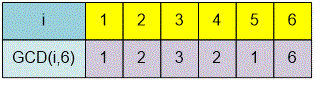
Then
At the same time
Let us compute using the formula g(n) = n \sum_{d \mid n} \frac{\varphi(d)}{d}
Now let us compute using the multiplicativity of the function f(x) = GCD(x, n):
Example. Let n = 12.

Then
At the same time
Let us compute using the formula g(n) = n \sum_{d \mid n} \frac{\varphi(d)}{d}:
The divisors of are: 1, 2, 3, 4, 6, 12. The number of integers such that GCD(i, 12) = d is . For example, GCD(i, 12) = 3 holds for ϕ(12/3) = ϕ(4) = 2 different values of , namely i = 3, 9.
Now let us compute using the multiplicativity of the function f(x) = GCD(x, n):
Algorithm implementation
The euler function computes Euler’s totient function.
long long euler(long long n)
{
  long long i, result = n;
  for (i = 2; i * i <= n;i++)
  {
    if (n % i == 0) result -= result / i;
    while (n % i == 0) n /= i;
  }
  if (n > 1) result -= result / n;
  return result;
}The main part of the program. Read the value of . Compute the value of using the formula \sum_{e \mid n} e \varphi\left(\frac{n}{e}\right). We look for all divisors of among the numbers from to \lfloor \sqrt{n} \rfloor.
If is a divisor of , then is also a divisor of . Therefore, when we find each divisor i \le \lfloor \sqrt{n} \rfloor, we should add i \phi(\frac{n}{i}) + \frac{n}{i} \phi(i) to the result , taking into account both divisors and .
If is a perfect square and i = sq = \left\lfloor \sqrt{n} \right\rfloor, then the divisors and are the same. In this case, iϕ(\frac{n}{i}) = \frac{n}{i} ϕ(i) will be added twice to the sum as two identical terms. Therefore, subtract one of them from during the initialization of this variable.
while(scanf("%lld",&n) == 1)
{
  sq = (long long)sqrt(1.0*n);
  res = (sq * sq == n) ? -sq * euler(sq) : 0;

  for (i = 1; i <= sq; i++)
    if(n % i == 0) res = res + i * euler(n/i) + (n / i) * euler(i);
  printf("%lld\n",res);
}Algorithm implementation – using multiplicativity
Let us factor the number into prime factors:
We have proved that the function g(n) = \sum_{i=1}^{n} \gcd(i,n) is multiplicative. Therefore
For a power of a prime number, we have proved the following formula:
These are the two formulas used directly in the program.
Process several test cases. Read the value of .
while(scanf("%lld",&n) == 1)
{
In the variable , we'll compute the value of .
res = 1;Factor the number into prime factors. Iterate over possible divisors.
  for (i = 2; i * i <= n; i++)
  {
If the number is a prime factor, extract the factor p = i^a.
    if (n % i == 0)
    {
      a = 0; p = 1;
      while(n % i == 0)
      {
        a++;
        p *= i;
        n /= i;
}Multiply the result by
      res *= (a + 1) * p - a * p / i;
    }
  }
If n > 1, then is the last prime factor.
if (n > 1) res *= (2*n - 1);Print the answer.
  printf("%lld\n",res);
}
Java implementation
import java.util.Scanner;

public class Main
{
  static long euler(long n)
  {
    long result = n;
    for(int i = 2; i <= Math.sqrt(n);i++)
    {
      if (n % i == 0) result -= result / i;
      while (n % i == 0) n /= i;
    }
    if (n > 1) result -= result / n;
    return result;
  }

  public static void main(String[] args)
  {
    Scanner con = new Scanner(System.in);
    while(con.hasNext())
    {
      long n = con.nextLong();
      long sq = (long)Math.sqrt(n);
      long res = (sq * sq == n) ? -sq * euler(sq) : 0;
      for(long i = 1; i <= sq; i++)
        if (n % i == 0)
          res = res + i * euler(n/i) + (n / i) * euler(i);
      System.out.println(res);
    }
    con.close();
  }
}