Twice bigger#11286

We call the interval A[i \ldots j] good if all of its elements lie in the range [A_i; 2 \cdot A_i]. Since the array is sorted, it suffices that A_j \le 2 \cdot A_i.
We maintain two pointers and such that points to the first element that does not belong to the good interval starting at . In other words, the interval [i \ldots j - 1] is good, while the interval [i \ldots j] is bad.
For example, for the following sequence:
the intervals [2; 2], [2; 3], [2; 4], and are good.
the intervals [2; 6], [2; 7] are bad.
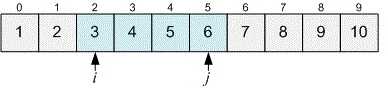
At each step, we perform one of two actions:
if is within the array bounds and A_j \le 2 \cdot А_i, we extend the window by incrementing by ;
otherwise, the window for the current is maximal: we print the answer j - i and shift the left boundary by incrementing by .
Each pointer only moves forward and traverses the array at most once, so the time complexity of the algorithm is .
Example
Let's consider the movement of pointers for the given example.
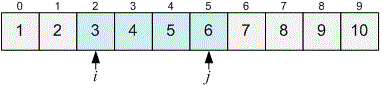
For the given condition A_j \le 2 \cdot A_i, so we move the pointer forward.
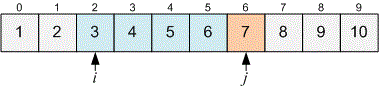
Now A_j > 2 \cdot A_i. We need to move the pointer forward. However, before moving it, print the number of elements lying between A_i and 2 \cdot A_i inclusive. It is equal to j - i = 6 - 2 = 4.
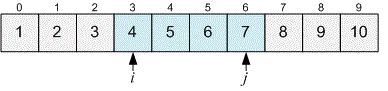
Move forward until A_j \le 2 \cdot A_i.
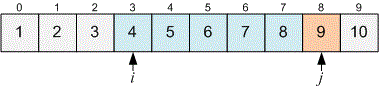
Now A_j > 2 \cdot A_i. Print the answer for i = 3 (it equals j - i = 8 - 3 = 5) and increase by .
Algorithm realization
Read the input data.
scanf("%d", &n);
for (i = 0; i < n; i++)
  scanf("%d", &a[i]);
Initialize the pointers i = j = 0.
i = j = 0;Move the pointers forward until an answer is found for each value of i < n.
while (i < n) // [i..j]
{
If A_j \le 2 \cdot A_i (and has not exceeded the array bounds, meaning j < n), extend the current interval by incrementing the pointer .
  if ((j < n) && (a[j] <= 2 * a[i])) j++;
  else
  {
If A_j > 2 \cdot A_i, print the answer for index and increment by one.
    printf("%d ", j - i);
    i++;
  }
}
Algorithm realization — binary search, O(n log n)
Read the input data.
scanf("%d", &n);
v.resize(n);
for (i = 0; i < n; i++)
  scanf("%d", &v[i]);
For each index i < n, using binary search, find the largest value of the index such that the numbers from A_i to 2 \cdot A_i are contained in the interval [i; x - 1], and A_x > 2 \cdot A_i. The count of numbers in the interval [i; x - 1] equals x - i.
for (i = 0; i < n; i++)
{
  x = upper_bound(v.begin(), v.end(), 2 * v[i]) - v.begin();
  printf("%d ", x - i);
}
Java realization
import java.util.*;

public class Main
{
  public static void main(String[] args)
  {
    Scanner con = new Scanner(System.in);
    int n = con.nextInt();
    int m[] = new int[n];
    for(int i = 0; i < n; i++)
      m[i] = con.nextInt();

    int i = 0, j = 0;
    while (i < n) // [i..j]
    {
      if ((j < n) && (m[j] <= 2 * m[i])) j++;
      else
      {
        System.out.print(j - i + " ");
        i++;
      }
    }

    con.close();
  }
}Python realization
Read the input data.
n = int(input())
lst = list(map(int,input().split()))
Initialize the pointers i = j = 0.
i = j = 0Move the pointers forward until an answer is found for each value of i < n.
while (i < n): # [i..j]If A_j \le 2 \cdot A_i (and has not exceeded the array bounds, meaning j < n), extend the current interval by incrementing the pointer .
  if (j < n and lst[j] <= 2 * lst[i]):
    j += 1
  else:
If A_j > 2 \cdot A_i, print the answer for index and increment by one.
    print(j - i, end=" ");
    i += 1
Python realization — binary search, O(n log n)
from bisect import bisect_rightRead the input data.
n = int(input())
v = list(map(int, input().split()))
For each index i < n, using binary search, find the largest value of the index such that the numbers from A_i to 2 \cdot A_i are contained in the interval [i; x - 1], and A_x > 2 \cdot A_i. The count of numbers in the interval [i; x - 1] equals x - i.
for i in range(n):
  x = bisect_right(v, 2 * v[i])
  print(x - i, end=" ")