Maximize It!#11319

Let’s consider the values that the expression f(i, j) = i / n - j / m takes, where i, j \in Z for fixed and . For example, f(n, m) = n / n - m / m = 0.
Let’s consider, for instance, the function f(i, j) = i / 3 - j / 5. Then
According to the extended Euclidean algorithm, there always exist integers and , such that i / 3 - j / 5 = 1. Therefore, the smallest positive value that the expression i / 3 - j / 5 can take is . From this, it follows that this expression can take all possible values of the form , where k \in Z.
Theorem. If f(i, j) = i / n - j / m, then this function takes values of the form k / LCM(n, m), where k \in Z.
Proof. Indeed,
Since the numbers m / GCD (n, m) and n / GCD(n, m) are coprime, there always exists integers and such that the numerator of the fraction equals . Therefore, the function f(i, j) can take all possible values of the form k / LCM(n, m), where k ∈ Z.
Now let's consider the original function
Its values are the distances from the point to the nearest point of the form k / LCM(n, m), where k \in Z. To maximize the function , the value of should be chosen so that it is exactly in the middle between the neighboring points k / LCM(n, m) and (k + 1) / LCM(n, m), where is an integer. The value of the function at such a point is 1 / 2 \cdot LCM(n, m), which will be the answer.
Example
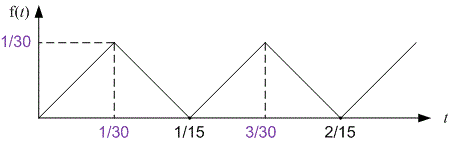
Let f(t) = min_{i,j \in Z} |{i \over 3} - {j \over 5} + t|. It is obvious that f(0) = 0. The equality f(1 / 15) = 0 holds because there exist integers and such that i / 3 - j / 5 = -1 / 15 (for example, i = 1, j = 2). From this, it also follows that f(k / 15) = 0, where k \in Z.
However, f(k / 15 + 1 / 30) = 1 / 30, and this will be the maximum value of the function, as the point k / 15 + 1 / 30 is at the maximum distance from the zeros of the function.
Algorithm implementation
The gcd function computes the greatest common divisor of the numbers and .
long long gcd(long long a, long long b)
{
  return b == 0 ? a : gcd(b, a % b);
}
The lcm function computes the least common multiple of the numbers and .
long long lcm(long long a, long long b)
{
  return a / gcd(a, b) * b;
}
The main part of the program. Read the input data.
while (scanf("%lld %lld", &n, &m) == 2)
{
Compute and print the result.
  d = 2 * lcm(n, m);
  printf("%lld/%lld\n", 1, d);
}