Amazing Trick#11320

After shuffling, the -th card from the left is the card a[p[q[i]]]. The trick succeeds if for all the following equality holds:
Denote by p \circ q the composition of permutations: (p \circ q)[i] = p[q[i]], that is, is applied first and then . Let be the identity permutation. Then the condition of the trick can be written as a \circ p \circ q = I.
Apply the inverse permutation a^{-1} to both sides of the equality on the left, and then p^{-1}:
Thus, the permutation can be chosen arbitrarily, and then is uniquely determined: q[i] = p^{-1}[a^{-1}[i]]. A permutation without fixed points is called a derangement. The problem reduces to finding a derangement such that the permutation q = p^{-1} \circ a^{-1} is also a derangement.
Random choice. It is impossible to iterate over all permutations , so we choose at random:
generate a random permutation ; if it has a fixed point, move on to the next attempt;
compute q = p^{-1} \circ a^{-1};
if has no fixed points, the pair is the answer.
We make at most attempts. If none of them yields an answer, we print "Impossible".
Why it works. An answer does not exist only in a few cases with small :
n = 1 — there are no permutations without fixed points at all;
n = 2 and a = (2, 1) — the only derangement p = (2, 1) gives q = (1, 2);
n = 3 and swaps exactly two elements. The only derangements of length are the cyclic shifts (2, 3, 1) and (3, 1, 2). The composition of two cyclic shifts is again a cyclic shift or the identity permutation, so a permutation that swaps two elements cannot be obtained.
For n \ge 4, an answer always exists. Moreover, as an exhaustive search for small shows, the fraction of suitable permutations among all permutations is at least (the minimum is reached at n = 4), and as grows it approaches 1/e^2 \approx 0.135. Therefore, the probability of not finding an answer in attempts does not exceed (11/12)^{1000} < 10^{-37}, which is practically zero. If no answer exists, none of the attempts will succeed, and the program will correctly print "Impossible".
Example
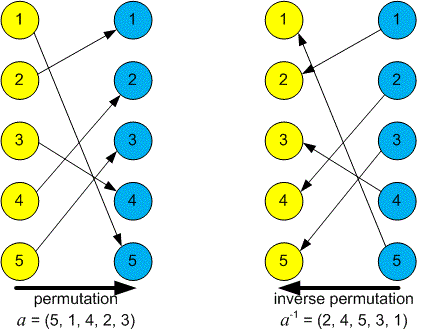
Consider the fourth test: a = (5, 1, 4, 2, 3).
Let us find the inverse permutation: if a[i] = x, then a^{-1}[x] = i. Since a[1] = 5, a[2] = 1, a[3] = 4, a[4] = 2, a[5] = 3, we get a^{-1} = (2, 4, 5, 3, 1). The figure shows the permutation on the left and its inverse on the right: all arrows are reversed.
Generate a random permutation without fixed points. Let, for example, p = (4, 1, 2, 5, 3). Its inverse is p^{-1} = (2, 3, 5, 1, 4).
Compute q[i] = p^{-1}[a^{-1}[i]]:
We get q = (3, 1, 4, 5, 2). The permutation has no fixed points, so the pair is the answer. It coincides with the answer from the example.
Let us check that the trick succeeds, that is, a[p[q[i]]] = i:
In the first test, n = 2 and a = (2, 1), so a^{-1} = (2, 1). The only permutation of length without fixed points is p = (2, 1), and p^{-1} = (2, 1). Then q = p^{-1} \circ a^{-1} = (1, 2) is the identity permutation, all of whose points are fixed. The answer is "Impossible".
Algorithm implementation
The print function prints the elements of the array , starting from the first one.
void print(vector<int>& a)
{
  for (int i = 1; i < a.size(); i++)
    printf("%d ", a[i]);
  printf("\n");
}
The function is_valid checks whether the permutation contains any fixed points.
bool is_valid(vector<int>& v)
{
  for (int i = 1; i < v.size(); i++)
    if (v[i] == i) return false;
  return true;
}
Declare the arrays.
vector<int> a, p, p1, q;The main part of the program. Read the input data.
scanf("%d", &tests);
while (tests--)
{
  scanf("%d", &n);
Initialize the arrays.
  a.resize(n + 1);
  p1.resize(n + 1);
  p.resize(n + 1);
  q.resize(n + 1);
Read the input permutation and immediately store its inverse in the array . That is, the array contains the permutation a^{-1}, where is the input permutation.
  for (i = 1; i <= n; i++)
  {
    scanf("%d", &x);
    a[x] = i;
  }
mt19937 is one of the standard pseudorandom number generators in C++ (Mersenne Twister with a period of 19937). It is very fast and has good statistical properties, making it an excellent choice for most tasks requiring random number generation.
mt19937 gen(random_device{}());In the variable , we'll mark whether a solution is found for the current test.
found = false;Perform iterations.
  for (it = 0; it < 1000; it++)
  {
Generate a random permutation. To do this, populate the array with the numbers 0, 1, 2, ..., and use the shuffle function to shuffle the elements, starting from the first (non-zero) element. We work with permutations from to .
    iota(p.begin(), p.end(), 0);
    shuffle(p.begin() + 1, p.end(), gen);
Check whether the permutation is valid (i.e., it contains no fixed points).
if (!is_valid(p)) continue;Compute the permutation p_1 = p^{-1}.
    for (i = 1; i <= n; i++)
      p1[p[i]] = i;
Compute the permutation q = p_1 ° a^{-1} = p^{-1} ° a^{-1}.
    for (i = 1; i <= n; i++)
      q[i] = p1[a[i]];
If the permutation is valid, print the result.
    if (is_valid(q))
    {
      puts("Possible");
      print(p);
      print(q);
      found = true;
      break;
    }
}If no solution is found after iterations, then no solution exists.
  if (!found) puts("Impossible");
}