Next greater Element#11456

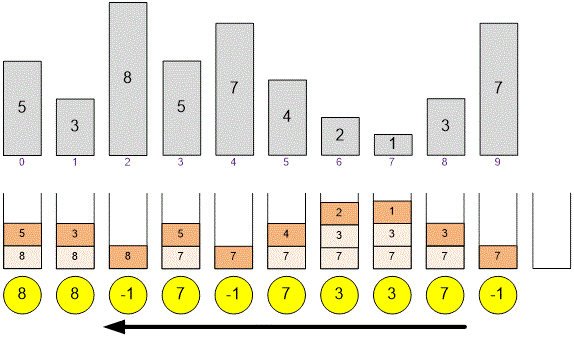
Let's declare a stack of integers that will be used to store information about the next greater elements. We'll process the elements of the array sequentially — from right to left. When processing the element at index :
Remove from the stack all numbers less than or equal to ;
If the stack is not empty, the number on top of the stack is the next greater element for ; if the stack is empty, assign as the next greater element;
Then, push onto the stack.
At any moment, the stack contains numbers in decreasing order. When the next number is processed, all elements less than or equal to it are removed from the stack, and then this number is pushed onto the top of the stack.
Example
Let’s take a look at how the elements are processed using an example.
Algorithm implementation
Read the input data.
scanf("%d", &n);
m.resize(n);
for (i = 0; i < n; i++)
  scanf("%d", &m[i]);
Process the numbers sequentially from right to left.
for (i = n - 1; i >= 0; i--)
{
Remove from the top of the stack all numbers less than or equal to .
while (!s.empty() && (s.top() <= m[i])) s.pop();The next greater element after is the number on top of the stack. If the stack is empty, store in the result array .
  if (s.empty()) res.push_back(-1);
  else res.push_back(s.top());
Push the number onto the stack.
  s.push(m[i]);
}
Reverse and print the resulting array.
reverse(res.begin(), res.end());
for (i = 0; i < n; i++)
  printf("%d ", res[i]);
printf("\n");
Python implementation
Read the input data.
n = int(input())
m = list(map(int, input().split()))
Initialize the lists.
res = []
s = []
Process the numbers sequentially from right to left.
for i in range(n - 1, -1, -1):Remove from the top of the stack all numbers less than or equal to .
  while s and s[-1] <= m[i]:
    s.pop()
The next greater element after is the number on top of the stack. If the stack is empty, store in the result array .
  if not s:
    res.append(-1)
  else:
    res.append(s[-1])
Push the number onto the stack.
s.append(m[i])Reverse and print the resulting list.
res.reverse()
print(*res)