Two digits#115

We begin solving the problem by considering the base cases:
for n = 1, there are only two valid numbers: and .
for n = 2, there are only four valid numbers: and .
Let denote the number of valid -digit numbers. Then:
f(1) = 2;
f(2) = 4;
Next, we construct -digit numbers based on already constructed numbers of smaller length.
Adding one digit. Take all previously constructed (n - 1)-digit numbers and append to each of them a digit different from its last digit. In this way, we obtain -digit numbers ending with 559, 595, 959 and . The total number of such numbers is f(n - 1).
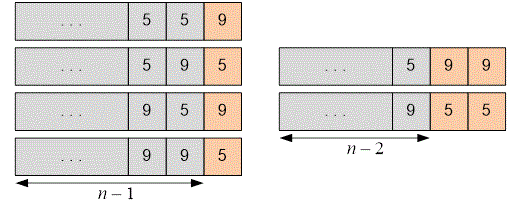
Adding two identical digits. We also include among the -digit numbers those that can be obtained from (n - 2)-digit numbers by appending two fives or two nines, ensuring that no three identical digits appear consecutively at the end. That is, we also obtain numbers ending with and . Thus, we get an additional f(n - 2) valid numbers.
Therefore, we obtain the following recurrence relation:
Example
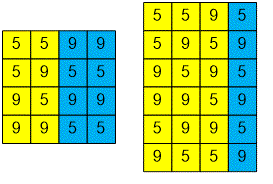
There are four valid two-digit numbers: and .
There are six valid three-digit numbers: 559, 595, 959, 995, 599 and . They are obtained:
from two-digit numbers: 55 → 559, 59 → 595, 95 → 959, 99 → 995
from one-digit numbers: 5 → 599, 9 → 955
All valid four-digit numbers are obtained:
from three-digit numbers by appending a digit different from the last one: 5595, 5959, 9595, 9959, 5995 and .
from two-digit numbers by appending or in such a way that three identical digits do not appear consecutively: 5599, 5955, 9599 and .
Algorithm implementation
We'll store the values in the array elements .
int m[31];Read the input value .
scanf("%d", &n);Set the initial values: f(1) = 2 and f(2) = 4.
m[1] = 2; m[2] = 4;Compute the values m[i]~(3 \le i \le n) using the recurrence relation.
for(i = 3; i <= n; i++)
  m[i] = m[i-1] + m[i-2];
Print the result — the value .
printf("%d\n",m[n]);Java implementation
import java.util.*;

public class Main
{
  public static int MAX = 32;
  static int m[] = new int[MAX];

  public static void main(String[] args)
  {
    Scanner con = new Scanner(System.in);
    int n = con.nextInt();
    m[1] = 2; m[2] = 4;
    for(int i = 3; i <= n; i++) m[i] = m[i-1] + m[i-2];
    System.out.println(m[n]);
  }
}Python implementation
Read the input value .
n = int(input())Initialize the list .
m = [0] * 31Set the initial values: f(1) = 2 and f(2) = 4.
m[1] = 2
m[2] = 4
Compute the values m[i]~(3 \le i \le n) using the recurrence relation.
for i in range(3, n + 1):
  m[i] = m[i - 1] + m[i - 2]
Print the result — the value .
print(m[n])Written By : MathModel (Hasan Saleh)
Notice that (n \le 30) which is small , if we notice that we can optimize the brute force by cancelling the invalid cases early.
We build the number digit by digit using recursion f(\text{current index},\text{last digit},\text{count of last digit in a row}) , let's denote it as f(a,b,c) in code.
Now we start the recursion starting with a=0 (meaning 0-based indexing) , can be anything initially because we don't have anything yet , b=0 is valid , now c=0 from our state.
We try both ways :
adding a and adding a
if c<2 i.e. we can call the last digit one more time we call
otherwise we call
we keep calling until a=n then we're done.
def f(a,b,c):
    if(a==n):
       return 1
    r=0
    for d in [5,9]:
        if(d==b):
            if(c<2):
                r+=f(a+1,d,c+1)
        else:
            r+=f(a+1,d,1)
    return r

n=int(input())
print(f(0,0,0))Complexity \mathcal{O}(1.6^n).
BONUS : prove the complexity