x1+...+xk = n#11550

Let's use the "stars and bars" method. Write down ones in a row: . There are n - 1 gaps between adjacent ones. Choose any k - 1 of these gaps and put a '' sign into each chosen gap. The ones are then split into consecutive groups; let x_i denote the number of ones in the -th group. For example, for n = 6 the string 11+111+1 corresponds to the solution (2, 3, 1) of the equation x_1 + x_2 + x_3 = 6.
Each such arrangement defines a solution of the equation in positive integers. Indeed, the sizes of all groups add up to , and every group is non-empty: a '' sign is never placed before the first one or after the last one, and no gap can contain two signs. Therefore, all x_i \ge 1.
There is a one-to-one correspondence between the solutions of the equation and the ways to choose k - 1 gaps out of n - 1. Hence, the required number of solutions equals C_{n-1}^{k-1}.
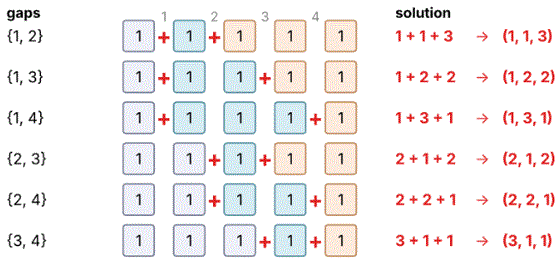
For example, for n = 5, k = 3 there are n - 1 = 4 gaps, of which k - 1 = 2 must be chosen. This can be done in C_4^2 = 6 ways, and each choice corresponds to exactly one solution of the equation x_1 + x_2 + x_3 = 5:
Example
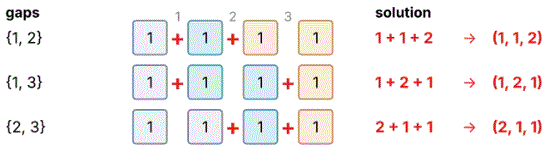
Consider the equation x_1 + x_2 + x_3 = 4. It has positive integer solutions: (1, 1, 2), (1, 2, 1), (2, 1, 1).
For example, n = 4 ones can be divided into k = 3 terms in C_2^3 = 3 ways:
Note
Let’s consider a few variations of this problem:
A teacher brought identical candies to class and wants to distribute them among students so that each student receives at least one candy. Find how many ways this can be done.
There are identical notebooks on a desk. They need to be arranged into piles so that each pile contains at least one notebook. Determine how many ways this can be done.
Algorithm implementation
The Cnk function computes the value of the binomial coefficient C_n^k.
long long Cnk(long long k, long long n)
{
  long long res = 1;
  if (k > n - k) k = n - k;
  for (long long i = 1; i <= k; i++)
    res = res * (n - i + 1) / i;
  return res;
}The main part of the program. Read the input data.
scanf("%lld %lld", &k, &n);Compute and print the answer – the value of C_{n-1}^{k-1}.
res = Cnk(k - 1, n - 1);
printf("%lld\n", res);
Python implementation
import mathRead the input data.
k, n = map(int,input().split())Compute and print the answer – the value of C_{n-1}^{k-1}.
res = math.comb(n - 1, k - 1)
print(res)