Jim and the Skyscrapers#11720

Imagine that we are building "walls" out of blocks of the same height.
A pair forms a "corridor" if there is no taller block between these walls. To solve the problem, we'll use a monotone stack. The stack stores pairs (value, count):
— the height of the wall (the value ).
— the number of consecutive elements of this height that have already appeared and can form pairs with future elements of the same height.
That is:
For each "block of identical numbers", we remember only two parameters: the number itself and how many times it has appeared consecutively so far.
When a new element appears, we can immediately determine how many pairs it forms: this number is exactly for the element at the top of the stack.
For example, let the current number be a = 5, and suppose it has already appeared times (that is, the current occurrence of a = 5 is the fourth one). Assume that between all these occurrences of a there are only smaller elements. Then the number of new index pairs , where is the current index and the condition h_i = h_j = a holds, will be .
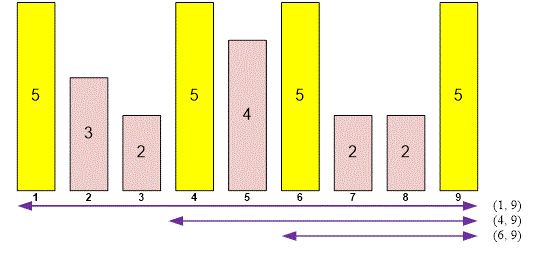
When processing the next number h_i:
If the number at the top of the stack is less than h_i, remove it from the stack.
If the number at the top of the stack is equal to h_i and it has appeared previously times, increase the target count of index pairs by and update the number of occurrences of h_i to x + 1.
If the stack is empty or the number at the top of the stack is greater than h_i, push the pair (h_i, 1) onto the stack. This means that the current value h_i appears for the first time (it may have appeared earlier in the input sequence but was removed from the stack due to a larger element).
Example
Consider the first test case.
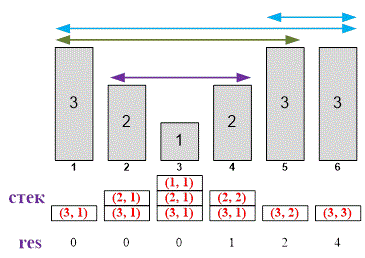
Algorithm implementation
Read the input data.
scanf("%d", &n);
vector<int> v(n);
for (i = 0; i < n; ++i)
  scanf("%d", &v[i]);
Store the number of found index pairs in the variable .
res = 0;Declare a stack of pairs.
stack<pair<int, int>> st;Process all the numbers of the array sequentially.
for (i = 0; i < v.size(); i++)
{
While the number at the top of the stack is less than , remove it from the stack.
  while (!st.empty() && st.top().first < v[i])
    st.pop();
If the number at the top of the stack is equal to and it has appeared previously times (the value is stored in st.top().second), increase the answer by . Then update the number of occurrences of to x + 1.
  if (!st.empty() && v[i] == st.top().first)
  {
    res += st.top().second;
    st.top().second += 1;
  }
  else
If appears for the first time, push the pair (v[i], 1) onto the stack.
    st.push({ v[i], 1 });
}
Print the answer.
printf("%lld\n", res);