Gift for Anton#11815

Anton wants to receive as a gift a rectangular table of size n\times m filled with the numbers , , , , or .
Anton will be happy if there is no other next to each , exactly one other next to each , exactly two other s next to each , exactly three other s next to each , and exactly four other s next to each (i.e., all neighbors of must also be ).
One cell is considered to be next to another if they share a side.
You need to come up with a table that can be gifted to Anton so that he will be happy.
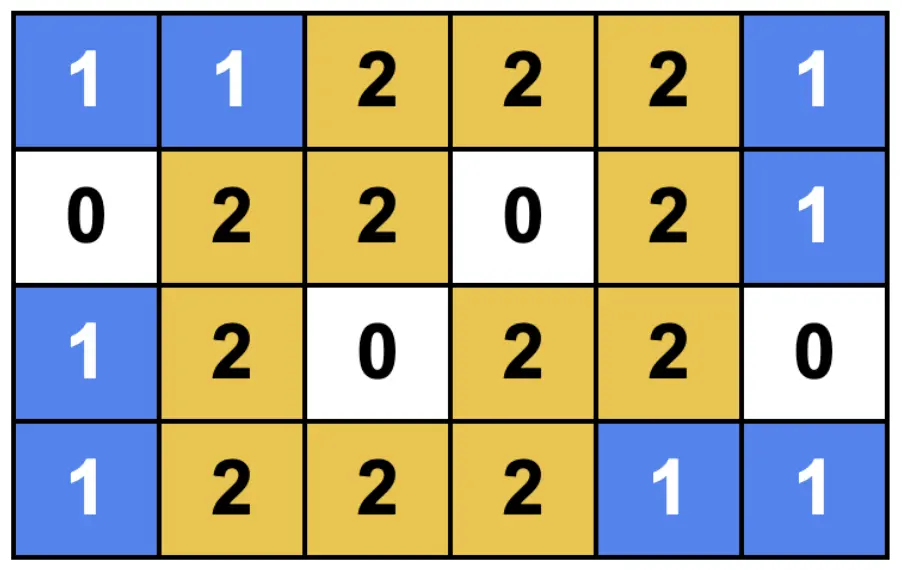
Below is an example of a table that will make Anton happy with n=4, m=6.
A single line contains two numbers (1 \leq n, m \leq 200) — the dimensions of the table.
It can be shown that a solution always exists.
Output a table with rows and columns — a gift for Anton.
Example 1
( points): n = 1;
( points): n = 2;
( points): n = 3;
( points): n = m = 4;
( points): n = m = 30;
( points): n = 30, m = 31;
( points): n = 30, m = 32;
( points): n = m = 31;
( points): n = 31, m = 32;
( points): n = m = 32;
( points): no additional restrictions.