Slowdown Sprint#12234

There are runners in a marathon. Runner starts with an initial integer speed s_i>0, and after each unit of time, their speed is decreased by an integer t_i>0. A runner stops as soon as their speed becomes zero or negative. The total distance each runner travels is therefore the sum of their integer speeds at each integer time step while they are still running.
Runner number is Bob (where 1 \le b \le n). Compute Bob's final placement ( first place, second place, and so on) after all runners have stopped. A runner who travels strictly farther than Bob ranks ahead of him; runners who tie Bob (equal total distance) do not affect Bob's placement (i.e., they do not push him down).
The first line contains an integer (1 \le t \le 10^3) — the number of test cases.
Each test case is given as follows:
The first line contains two integers and (1 \le n \le 2 \cdot 10^5,\ 1 \le b \le n) — the number of runners and Bob's index.
The second line contains integers s_1, s_2, \dots, s_n (1 \le s_i \le 10^9) — initial speeds.
The third line contains integers t_1, t_2, \dots, t_n (1 \le t_i \le 10^9) — speed decrements per time unit.
It is guaranteed that the sum of over all test cases does not exceed 2 \cdot 10^5.
For each test case, print a single integer — Bob's final placement.
Example 1
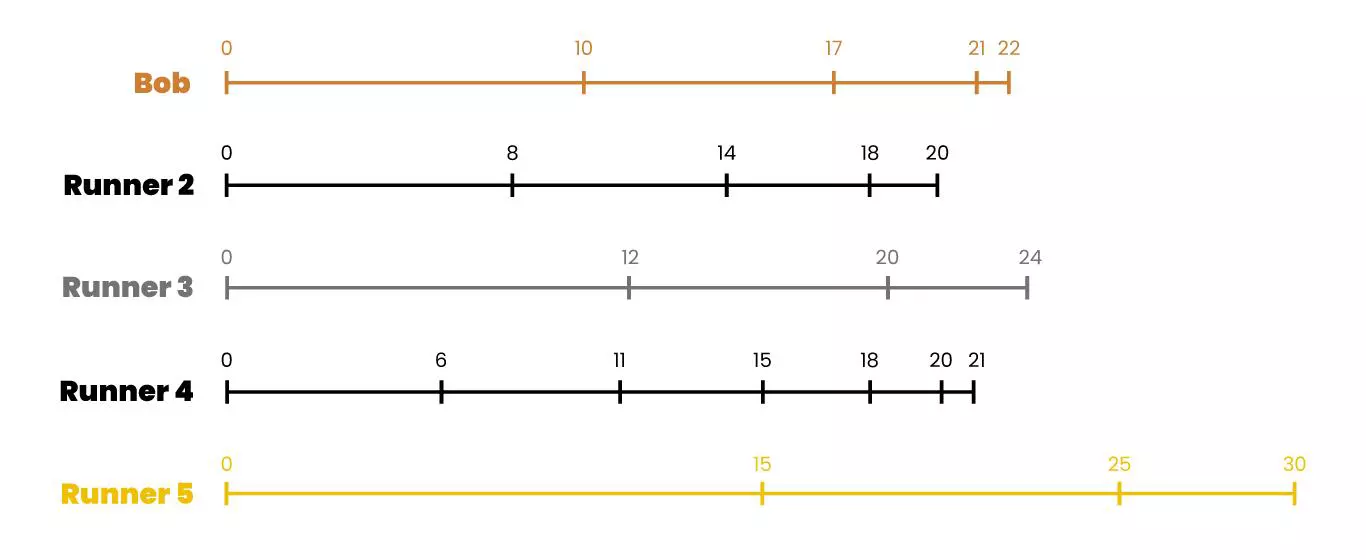
In the first test case, the following illustration describes the simulation:
Subtask ( points) : (1 \le n \le 10).
Subtask ( points) : (1 \le \sum n \le 2000)
Subtask ( points) : (t_1=t_2=...=t_n=1)
Subtask ( points) : It's guaranteed that Bob is either first or last.
Subtask ( points) : No additional constraints