Tree !#12252

"Tree of Life."
Polycarp has a tree of size . An edge of the tree is called balanced, if and only if it forms trees with the same number of ^\dagger leaves when cut. Polycarp wants to find the number of balanced edges in the tree, but he is not a great programmer. Therefore, he is calling you for help. Find the number of balanced edges in the tree.
Leaf is a node connected to exactly node by an edge.
The first line contains a single integer (1 \le t \le 10^4) – the number of tests.
The first line of each test contains a single integer (1 \le n \le 10^5) – the number of nodes in the tree.
The next n-1 lines contain two integers (1 \le u,v \le n, u \ne v) – meaning that there is an edge between nodes and .
It's guaranteed that the sum of over all tests doesn't exceed 2\cdot 10^5.
For each test, output a single integer, the number of balanced edges. If there are none, output .
Example 1
In the first test case:
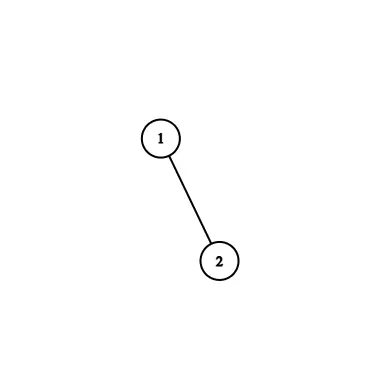
The only edge is balanced, as it forms two trees with leaves each when cut.
In the second test case:
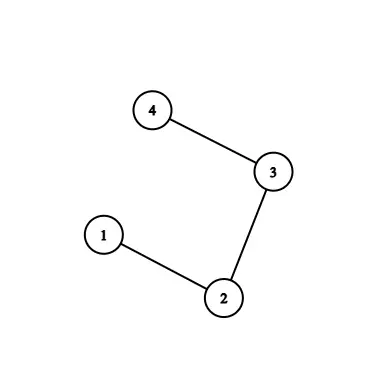
You can remove the edge and get two trees with leaves each.
In the third test case:
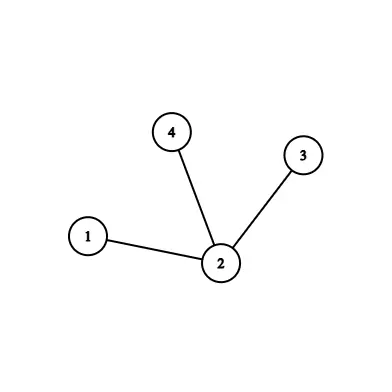
There are no balanced edges, as none form 2 trees with an equal number of leaves after cutting.
Subtask ( points) : (n \le 10)
Subtask ( points) : It's guaranteed that the tree is a line.
Subtask ( points) : (\sum n \le 2100)
Subtask ( points) : No additional constraints.