Fibonacci problem again#1250

Theorem. For the Fibonacci numbers, the following formula holds:
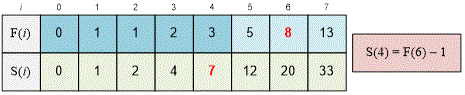
Proof. We prove the statement by induction.
Base case. For n = 0 we have:
That is, 0 = 1 - 1, which is true.
Inductive step. Assume that:
Then:
which completes the proof
Then the desired sum
can be computed as
Computing Fibonacci numbers using Binet's formula
Consider the generating function for the Fibonacci numbers (F_0 = 0, F_1 = 1):
From this it follows that:
Let us decompose the generating function into partial fractions. First, find the roots of the denominator:
where
Now represent the generating function as:
Solving the system, we obtain:
Taking into account that
the generating function can be rewritten as:
But since
equating the coefficients of x^n gives:
Computing Fibonacci Numbers Using an Identity
For the Fibonacci numbers, the following identity is known:
From it, the following special cases follow directly:
if m = n, then F_{2n} = F_n \cdot F_{n + 1} + F_{n - 1} \cdot F_n
if m = n + 1, then F_{2n + 1} = F_{n + 1} \cdot F_{n + 1} + F_n \cdot F_n
These formulas make it possible to compute Fibonacci numbers using a divide-and-conquer approach, reducing the computation of F_n to values with indices approximately half as large.
The base cases are handled separately:
With this approach, the recursion depth is proportional to log_2n, and the time complexity of the algorithm is O(log_2n).
Example
Let us compute some Fibonacci numbers using Binet’s formula, working in the extended field Z_p (\sqrt{5}) with a large modulus .
Let us illustrate the application of the formulas with an example:
if m = n, then F_{2n} = F_n \cdot F_{n + 1} + F_{n - 1} \cdot F_n
if m = n + 1, then F_{2n + 1} = F_{n + 1} \cdot F_{n + 1} + F_n \cdot F_n
Algorithm implementation
Declare the constant , which will be used as the modulus for all computations.
#define MOD 1000000007Declare a variable of type to store (memoize) already computed Fibonacci numbers.
map<long long, long long> fib;The function f computes the -th Fibonacci number modulo .
long long f(long long n)
{
  if (n == 0) return 0;
  if (n == 1) return 1;
  if (n == 2) return 1;
If the -th Fibonacci number has already been computed and stored in , it is returned immediately without recomputation.
if (fib[n]) return fib[n];Next, we decompose the number as follows:
n = 2k + 1 — odd case: F_n = F_k^2 + F_{k + 1}^2.
n = 2k — even case: F_n = F_k \cdot F_{k + 1} + F_{k - 1} \cdot F_k.
long long k = n / 2;Store the result and return it.
  if (n % 2 == 1) // n = 2*k + 1
    return fib[n] = (f(k) * f(k) + f(k + 1) * f(k + 1)) % MOD;
  else // n = 2*k
    return fib[n] = (f(k) * f(k + 1) + f(k - 1) * f(k)) % MOD;
}
The main part of the program. For each test case, read the input data and print the answer.
while (scanf("%lld %lld", &a, &b) == 2)
  printf("%lld\n", (f(b + 2) - f(a + 1) + MOD) % MOD);
Algorithm implementation – Binet's formula
Declare the constant , which will be used as the modulus for all computations.
#define MOD 1000000007Declare the structure to store a number of the form x + y \sqrt{5}.
struct Num
{
  long long x, y; // x + y*sqrt(c)
  Num(long long x_ = 0, long long y_ = 0) : x(x_), y(y_) {}
};
Implement multiplication in the field Z_p (\sqrt{5}). The function mult returns the product of the numbers and .
Num mult(Num& a, Num& b)
{
  Num res;
  res.x = (a.x * b.x + 5 * a.y % MOD * b.y) % MOD;
   res.y = (a.x * b.y + a.y * b.x) % MOD;
   return res;
}The function pow performs exponentiation of base^n, where is a number in the field Z_p (\sqrt{5}).
Num pow(Num base, long long n)
{
  Num res = { 1, 0 }; // единица поля
  while (n > 0)
  {
    if (n & 1)
      res = mult(res, base);
    base = mult(base, base);
    n >>= 1;
  }
  return res;
}The function modpow computes the value of a^k~mod~p.
long long pow(long long x, long long n)
{
  long long res = 1;
  x %= MOD;
  while (n > 0)
  {
    if (n & 1) res = res * x % MOD;
    x = x * x % MOD;
    n >>= 1;
  }
  return res;
}The function fib computes the -th Fibonacci number.
long long fib(long long n)
{
Initialize the constants φ = 1 + \sqrt{5} and ψ = 1 - \sqrt{5}.
  Num phi(1, 1);
  Num psi(1, MOD - 1);
Compute the powers A = φ^n and B = ψ^n.
  Num A = pow(phi, n);
  Num B = pow(psi, n);
Since
compute the numerator and denominator separately.
Note that A_x = B_x (so A_x - B_x = 0), and the coefficient of \sqrt{5} in the numerator is A_y - B_y.
long long numerator = (A.y - B.y + MOD) % MOD;Compute 2^n in the denominator.
long long denom = pow(2, n);Both the numerator and the denominator contain a factor of \sqrt{5}. Cancel this factor, leaving the result to be computed as:
  long long denom_inv = pow(denom, MOD - 2);
  return numerator * denom_inv % MOD;
}
The main part of the program. For each test case, read the input data and print the answer.
while (scanf("%lld %lld", &a, &b) == 2)
  printf("%lld\n", (fib(b + 2) - fib(a + 1) + MOD) % MOD);