Best Chess Piece#12884

You decided that chess is boring, and it's time to create a new piece — a prawn. In one move, it can move forward by , or to any diagonally adjacent cell.
Formally, if the prawn is currently at the cell , then in one move, it can move to one of the cells (x, y+1), (x-1, y-1), (x-1, y+1), (x+1, y-1), (x+1, y+1).
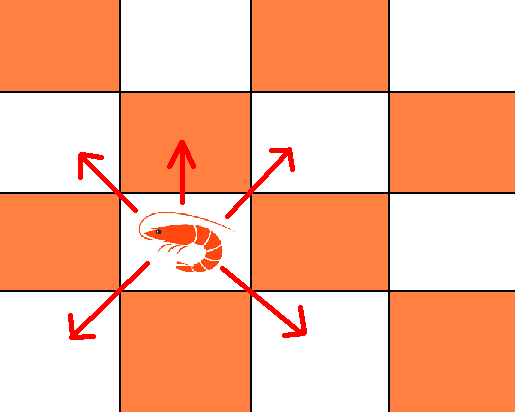
Currently, the prawn is at cell of the infinite board. At least how many moves does it need to make to get to the cell ?
The first line contains a single integer (1 \le t \le 10^4) — the number of test cases. The description of test cases follows.
The only line of each test case contains two integers (-10^9 \le a, b \le 10^9) — indicating that prawn needs to get to the cell .
For each test case, output a single integer — the smallest number of moves that the prawn has to make to get to the cell .
Example 1
In the first test case, the prawn is already at its destination, so the answer is .
In the second test case, one of the possible routes for the prawn is (0, 0) \to (1, 1) \to (2, 2) \to \ldots \to (1000, 1000).
In the third test case, one of the possible routes for the prawn is (0, 0) \to (0, 1) \to (1, 0) \to (0, -1).