Exam Session#13106

Oksana is a student of the Faculty of Cybernetics, and her exam session is unusually flexible this year. She has to pass exams. The days of the session are numbered with positive integers, and the -th exam can be taken on any day from day l_i to day r_i inclusive.
Oksana does not want to overload herself, so she is going to take at most one exam per day. Each exam has to be taken exactly once.
Determine whether Oksana can choose a day for every exam so that she passes all exams. Formally, check whether there exist integers x_1, x_2, \ldots, x_n such that l_i \le x_i \le r_i for every and all x_i are pairwise distinct.
The first line contains a single integer (1 \le t \le 10^5) — the number of test cases.
The first line of each test case contains an integer (1 \le n \le 2 \cdot 10^5) — the number of exams. Each of the next lines contains two integers l_i and r_i (1 \le l_i \le r_i \le 10^9) — the first and the last day on which the -th exam can be taken.
The sum of over all test cases does not exceed 2 \cdot 10^5.
For each test case print YES if Oksana can pass all exams, and NO otherwise.
You may print each letter in any case (for example, yes, Yes and YES are all accepted).
Example 1
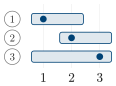
In the first test case Oksana can take the exams on days , and , respectively.
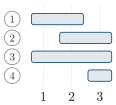
In the second test case all four exams must be taken on days from to , which is impossible.
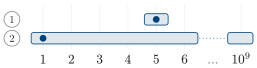
In the third test case she can take the first exam on day and the second exam on any other day, for example, on day .