Car race#1390

The problem provides an undirected connected graph. It is necessary to check whether it contains a cycle (which can be turned into a Formula-0 track).
An undirected graph contains a cycle if there is a back edge, i.e., an edge leading to a vertex that is already visited.
Example
The graphs given in the example are as follows:
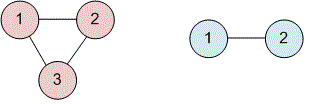
The first graph contains a cycle, while the second does not.
Algorithm implementation
The graph is stored in the adjacency matrix . The array used is used to mark the visited vertices.
#define MAX 1010
int g[MAX][MAX], used[MAX];
The dfs function implements depth-first search from vertex . It is necessary to exclude the case when we move from to its ancestor: the ancestor is already visited, but there is no cycle. To handle this, we will introduce a second parameter in the dfs function, representing the ancestor of vertex .
void dfs(int v, int p = -1)
{
Mark vertex as visited.
used[v] = 1;Iterate over the vertices that can be reached from .
  for (int i = 1; i <= n; i++)
  {
Consider all edges except for the one that leads to the ancestor .
if (i == p) continue;If there is an edge from to , and is already visited (used[i] = 1), then the graph contains a cycle. Set flag = 1.
    if (g[v][i] == 1)
    {
      if (used[i] == 1) flag = 1;
Otherwise, continue the depth-first search from vertex .
      else dfs(i, v);
    }
  }
}
The main part of the program. Read the input data.
scanf("%d %d",&n,&m);
memset(g,0,sizeof(g));
memset(used,0,sizeof(used));
Read the input undirected graph. The graph is stored in an adjacency matrix, so repeated roads will be counted only once.
for (i = 0; i < m; i++)
{
  scanf("%d %d",&u,&v);
  g[u][v] = g[v][u] = 1;
}
Set flag = 0, which indicates the absence of a cycle in the graph. If a cycle is found, the value of will change to .
flag = 0;Initiate depth-first search from vertex (according to the problem statement, the graph is connected).
dfs(1);Based on the value of , print the result.
if (flag) printf("YES\n");
else printf("NO\n");
Java implementation
import java.util.*;

public class Main
{
  static int g[][], used[];
  static int n, m, flag;

  static void dfs(int v, int prev)
  {
    used[v] = 1;
    for(int i = 1; i <= n; i++)
      if ((i != prev) && g[v][i] == 1)
        if (used[i] == 1) flag = 1; else dfs(i,v);
  }

  public static void main(String[] args)
  {
    Scanner con = new Scanner(System.in);
    n = con.nextInt();
    m = con.nextInt();
    g = new int[n+1][n+1];
    used = new int[n+1];

    for(int i = 0; i < m; i++)
    {
      int u = con.nextInt();
      int v = con.nextInt();
      g[u][v] = g[v][u] = 1;
    }

    flag == 0;
    dfs(1,-1);

    if (flag == 1) System.out.println("YES");
    else System.out.println("NO");
  }
} Python implementation
The dfs function implements depth-first search from vertex . It is necessary to exclude the case when we move from to its ancestor: the ancestor is already visited, but there is no cycle. To handle this, we will introduce a second parameter in the dfs function, representing the ancestor of vertex .
def dfs(v, p = -1):
  global flag
Mark vertex as visited.
used[v] = 1Iterate over the vertices that can be reached from .
for i in range(1, n + 1):Consider all edges except for the one that leads to the ancestor .
    if i == p:
      continue
If there is an edge from to , and is already visited (used[i] = 1), then the graph contains a cycle. Set flag = 1.
    if g[v][i] == 1:
      if used[i] == 1:
        flag = 1
Otherwise, continue the depth-first search from vertex .
      else:
        dfs(i, v)
The main part of the program. Read the input data.
n, m = map(int, input().split())
g = [[0] * (n + 1) for _ in range(n + 1)]
used = [0] * (n + 1)
Read the input undirected graph. The graph is stored in an adjacency matrix, so repeated roads will be counted only once.
for _ in range(m):
  a, b = map(int, input().split())
  g[a][b] = g[b][a] = 1
Set flag = 0, which indicates the absence of a cycle in the graph. If a cycle is found, the value of will change to .
flag = 0Initiate depth-first search from vertex (according to the problem statement, the graph is connected).
dfs(1)Based on the value of , print the result.
if flag == 1:
  print("YES")
else:
  print("NO")