Moon#1490

Beginner astronomer Dasha has finally acquired a digital camera. Capturing the starry sky with just a click and then conducting research is now much more convenient.
The camera's sensor resolution is not very high, so the photographs of the night sky distinguish only two colors: black and white. However, this has its advantages: Dasha has already taken numerous pictures, and the memory is still not full. Now, Dasha is interested in identifying the position of the Moon in each picture.
Assume the Moon in a picture appears as a circle with center at point and an integer non-negative radius . This means it consists of white points whose distance to point is no more than . The Moon is entirely contained within the picture.
Additionally, some sufficiently bright stars may appear in the picture as separate white dots. There are no more than such points. The picture contains no objects other than the Moon and stars.
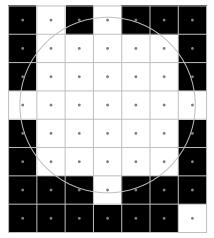
Write a program to determine the largest possible radius of the circle representing the Moon and its possible position.
The first line contains integers and — the horizontal and vertical resolution of the picture, respectively (1 \leq w, h \leq 50). The next lines contain characters: "." (black point) or "*" (white point).
Print a natural number: the maximum radius of the Moon's image. On the second line, print the coordinates (column, then row) of the center of the Moon's image with the given radius. Columns and rows are numbered starting from one, from left to right and top to bottom, respectively.
If there are multiple possible centers, print any one. It is guaranteed that a correct answer exists.
Example 1