Decreasing Number#1560

Let represent the minimum number of operations required to transform the number into . For example,
f(1) = 0, as we already have the number ;
f(2) = 1, perform operation 2 → 1;
f(5) = 3, perform operations 5 → 4 → 2 → 1;
f(10) = 3, perform operations 10 → 9 → 3 → 1;
In the case of n = 10, it is more advantageous to subtract first rather than using the greedy approach and dividing by .
Let’s consider the process of computing the function .
If we divide the number by (assuming is divisible by ), then
If we divide the number by (assuming is divisible by ), then
If we subtract from the number , then
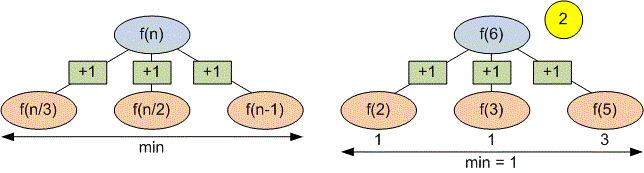
From the number , we can obtain one of three numbers: , or n - 1. The number of operations required to reduce each of these numbers to , is equal to f(n / 3), f(n / 2), and f(i - 1) respectively. Since we are interested in the minimum number of operations, we have the following relationship:
In the case, if is not divisible by (or by ), then the corresponding element ( or ) is absent in the function. For example, for n = 8, we have:
Similarly, for n = 7, we get:
The values of the function will be stored in the cells of the array d[MAX], where MAX = 10^6 + 1. Fill the cells of the array from to 10^6 according to the given recurrence relation. For example, the following table shows the values of for 1 \le i \le 11:
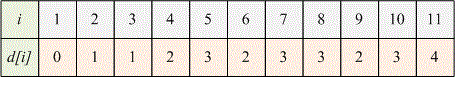
For example,
In other words, it is more efficient to subtract from , rather than divide it by .
Exercise
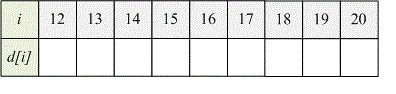
Find the values of for the following values of :
Algorithm implementation
Declare an array , where the -th cell contains the minimum number of operations required to transform the number into .
#define MAX 1000001
int d[MAX];
Fill the cells of array according to the provided formulas.
d[1] = 0;
for (i = 2; i < MAX; i++)
{
  // d[i] = min(d[i/3],d[i/2],d[i-1]) + 1
  d[i] = d[i - 1];
  if (i % 2 == 0) d[i] = min(d[i], d[i / 2]);
  if (i % 3 == 0) d[i] = min(d[i], d[i / 3]);
  d[i]++;
}For each input value , print the answer .
while(scanf("%d",&n) == 1)
  printf("%d\n",d[n]);
Algorithm implementation — recursion
#include <stdio.h>
#include <string.h>
#define INF 2000000000

int i, res, n;
int dp[1000001];

int min(int a, int b, int c)
{
  int res = a;
  if (b < res) res = b;
  if (c < res) res = c;
  return res;
}

int f(int n)
{
  if (n == 1) return 0;
  if (dp[n] != -1) return dp[n];
  int a = f(n - 1);
  int b = (n % 2 == 0) ? f(n / 2) : INF;
  int c = (n % 3 == 0) ? f(n / 3) : INF;
  return dp[n] = min(a,b,c) + 1;
}

int main(void)
{
  memset(dp, -1, sizeof(dp));
  while (scanf("%d", &n) == 1)
  {
    res = f(n);
    printf("%d\n", res);
  }
  return 0;
}Java implementation
import java.util.*;

public class Main
{
  public static int MAX = 1000001;
  static int d[] = new int[MAX];

  public static void main(String[] args)
  {
    Scanner con = new Scanner(System.in);
    d[1] = 0;
    for(int i = 2; i < MAX; i++)
    {
      d[i] = d[i-1] + 1;
      if (i % 2 == 0) d[i] = Math.min(d[i], d[i/2] + 1);
      if (i % 3 == 0) d[i] = Math.min(d[i], d[i/3] + 1);
   }

    while(con.hasNext())
    {
      int n = con.nextInt();
      System.out.println(d[n]);
    }
  }
}Python implementation
Create a list , where the -th cell contains the minimum number of operations required to transform the number into .
d = [0] * 1000001Fill the cells of array according to the provided formulas.
d[1] = 0
for i in range(2, 1000001):
  d[i] = d[i - 1]
  if i % 2 == 0 and d[i // 2] < d[i]:
    d[i] = d[i // 2]
  if i % 3 == 0 and d[i // 3] < d[i]:
    d[i] = d[i // 3]
d[i] += 1For each input value , print the answer .
while True:
  try:
    n = int(input())
    print(d[n])
  except EOFError:
    break