Second digit of the number#1605

If the input number is negative, compute its absolute value — this will not change the second digit. Then divide the number by until it is greater than . The last digit of the resulting number will be the second digit of the initial number.
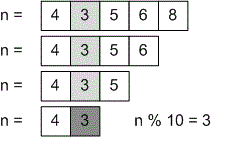
Algorithm implementation
Read the input number . Since it is -bit number, use the long long type. If it is negative, then change its sign to the opposite.
scanf("%lld",&n);
if (n < 0) n = -n;
Divide the number by until it is greater than .
while (n > 99) n /= 10;The last digit of the resulting number will be the second digit of the initial number. Print it.
res = n % 10;
printf("%lld\n",res);
Java implementation
import java.util.*;

public class Main
{
  public static void main(String []args)
  {
    Scanner con = new Scanner(System.in);
    long n = con.nextLong();
    if (n < 0) n = -n;

    while (n > 99) n /= 10;
    long res = n % 10;

    System.out.println(res);
    con.close();
  }
} Python implementation — arithmetic approach
Read the input number .
n = int(input())If the number is negative, then change its sign to the opposite.
if n < 0: n = -nDivide the number by until it is greater than .
while n > 99:
  n = n // 10
The last digit of the resulting number will be the second digit of the initial number. Print it.
res = n % 10
print(res)
Python implementation — string
Read the input number .
n = int(input())Compute the absolute value of the number . Then, convert it to a string, extract the first character (string indexing starts at zero), and convert it back to an integer.
res = int(str(abs(n))[1])Print the answer.
print(res)