Clever turtle#1704

Consider a two dimensional array , where dp[i][j] represents the number of ways the turtle can get from cell to cell . We set dp[1][1] = 1.
The turtle can reach cell either from cell (i - 1, j) or from cell (i, j - 1). Therefore, the following equality holds:
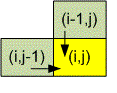
Initially, we'll zero out the array. Special attention is paid to zeroing the first row and first column of the dp array.
If i = 1, then dp[i - 1][j] = dp[0][j] = 0, and the dynamic programming equation simplifies to dp[1][j] = dp[1][j - 1]. This is how the first row is recalculated.
If j = 1, the formula becomes dp[i][1] = dp[i - 1][1]. This is how the first column is recalculated.
Given that dp[1][1] = 1, we can conclude that all cells in the first row and the first column will contain the value , which corresponds to the only way to reach each of these cells.
Example
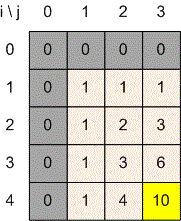
Fill the array for the grid of size 4 \times 3:
Algorithm implementation
Declare the array.
#define MAX 31
long long dp[MAX][MAX];
Read the input data.
scanf("%d %d",&m,&n);Initialize the array with zeroes. Set all cells in the first row and first column to .
memset(dp,0,sizeof(dp));
for(i = 1; i <= m; i++) dp[i][1] = 1;
for(j = 1; j <= n; j++) dp[1][j] = 1;
Recalculate the values of the array cells, starting from the second row and the second column.
for(i = 2; i <= m; i++)
for(j = 2; j <= n; j++)
  dp[i][j] = dp[i-1][j] + dp[i][j-1];
Print the answer.
printf("%lld\n",dp[m][n]);Java implementation
import java.util.*;

public class Main
{
  public static void main(String[] args)
  {
    Scanner con = new Scanner(System.in);
    int m = con.nextInt();
    int n = con.nextInt();
    long dp[][] = new long [m+1][n+1];

    for(int i = 1; i <= m; i++) dp[i][1] = 1;
    for(int j = 1; j <= n; j++) dp[1][j] = 1;

    for(int i = 2; i <= m; i++)
    for(int j = 2; j <= n; j++)
      dp[i][j] = dp[i-1][j] + dp[i][j-1];

    System.out.println(dp[m][n]);
    con.close();
  }
}Python implementation
Read the input data.
m, n = map(int,input().split())Declare the list.
dp = [[0] * (n + 1) for i in range(m + 1)]Set all cells in the first row and first column to .
for i in range(1, m + 1): dp[i][1] = 1
for j in range(1, n + 1): dp[1][j] = 1
Recalculate the values of the list cells, starting from the second row and the second column.
for i in range(2, m + 1):
  for j in range(2, n + 1):
    dp[i][j] = dp[i - 1][j] + dp[i][j - 1]
Print the answer.
print(dp[m][n])