Topological Sort#1948

A topological sort of a directed graph is an ordering of its vertices such that for every edge u \to v, vertex appears before vertex in the sequence. A topological sort exists if and only if the graph contains no directed cycles (that is, it is acyclic).
We solve the problem using depth-first search. Each vertex is assigned a color:
white — the vertex has not been visited yet;
gray — the vertex has been visited, but its processing is not finished (it is on the current recursion stack);
black — the vertex and all vertices reachable from it have been fully processed.
Initially, all vertices are white. We start a depth-first search from every white vertex. On entering a vertex, color it gray; on leaving it, color it black and append it to a list at that moment. The order of vertices in the topological sort is the reverse of the order in which they turn black: the first fully processed vertex will be the last in the sort, and the last processed vertex will be the first.
Cycle detection. If during the traversal we encounter an edge leading to a gray vertex, the graph contains a cycle and a topological sort is impossible — we print .
Complexity. Each vertex and each edge is processed exactly once, so the running time is O(n + m).
Example
The graph shown in the example has the following form:
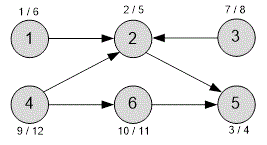
Next to each vertex , we place labels d[v] / f[v], where is the time when the vertex starts being processed, and is the time when its processing finishes. The topologically sorted vertices are arranged in decreasing order of the values of .
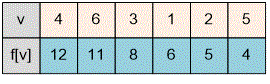
Algorithm implementation
Since the number of vertices in the graph is large, we'll store the graph as an adjacency list . To keep track of the state of the vertices, we use an array :
used[i] = 0, if vertex is not visited yet (vertex is white);
used[i] = 1, if vertex is visited, but its processing is not yet finished (vertex is gray);
used[i] = 2, if vertex is processed (vertex is black);
During the execution of the depth-first search, we'll add vertices to the array in the order of the completion of their processing. After the algorithm finishes, the array will contain the vertices in the reverse order of the topological sort.
vector<vector<int> > g;
vector<int> used, top;
The function dfs performs a depth-first search starting from vertex .
void dfs(int v)
{
We enter vertex and mark it gray.
used[v] = 1;Iterate over all vertices that can be reached from vertex .
  for (int to : g[v])
  {
If the directed edge (v, to) leads to a gray vertex, this indicates the presence of a cycle in the graph. In this case, set flag = 1.
if (used[to] == 1) flag = 1;If vertex is not visited yet, recursively start a depth-first search from it.
    if (used[to] == 0) dfs(to);
  }
We finish processing vertex . Mark it black and push it to the back of array.
  used[v] = 2;
  top.push_back(v);
}
The main part of the program. Read the input data and construct the adjacency list of the graph.
scanf("%d %d",&n,&m);
g.resize(n+1); used.resize(n+1);

for(i = 0; i < m; i++)
{
  scanf("%d %d",&a,&b);
  g[a].push_back(b);
}Perform a depth-first search on the directed graph.
flag = 0;
for(i = 1; i <= n; i++)
  if (used[i] == 0) dfs(i);
If a cycle is detected during the depth-first search (flag = 1), print .
if (flag == 1) printf("-1");
else
Otherwise, print the vertices of the graph in the reverse order of their addition to the array.
  for(i = top.size() - 1; i >= 0; i--)
    printf("%d ",top[i]);

printf("\n");
Algorithm implementation — Kahn
Store the input graph in the adjacency list .
The in-degrees of the vertices are stored in the InDegree array.
The result of the topological sort is stored in the array.
vector<vector<int> > g;
vector<int> InDegree, top;
deque<int> q;
Read the number of vertices and the number of edges .
scanf("%d %d",&n,&m);
g.resize(n+1);
InDegree.resize(n+1);
Read edges of the graph.
for(i = 0; i < m; i++)
{
  scanf("%d %d",&a,&b);
  g[a].push_back(b);
For each edge , we increment InDegree[b] by .
  InDegree[b]++;
}
All vertices with zero in-degree are added to the queue .
for(i = 1; i < InDegree.size(); i++)
  if (!InDegree[i]) q.push_back(i);
Continue the algorithm until the queue is empty.
while(!q.empty())
{
Dequeue vertex and add it to the end of the topological order list.
  v = q.front(); q.pop_front();
  top.push_back(v);
Remove the edges (v, to) from the graph. For each such edge, decrement the in-degree of vertex .
  for (int to : g[v])
  {
    InDegree[to]--;
If the in-degree of vertex becomes zero, add it to the queue. It will then be placed in the topological order list.
    if (!InDegree[to]) q.push_back(to);
  }
}
If not all vertices are added to the array, then the graph contains a cycle, and topological sorting is not possible.
if (top.size() < n)
  printf("-1\n");
else
{
Otherwise, print the vertices of the graph in topological order.
  for (int x : top) printf("%d ", x);
  printf("\n");
}
Java implementation — depth first search
import java.util.*;
import java.io.*;

public class Main
{
  static ArrayList<ArrayList<Integer>> g;
  static ArrayList<Integer> top = new ArrayList<Integer>();
  static int used[];
  static int n, m, flag = 0;

  static void dfs(int v)
  {
    used[v] = 1;
    for(int i = 0; i < g.get(v).size(); i++)
    {
      int to = g.get(v).get(i);
      if (used[to] == 1) flag = 1;
      if (used[to] == 0) dfs(to);
    }
    used[v] = 2;
    top.add(v);
  }

  public static void main(String[] args)
  {
    FastScanner con = new FastScanner(System.in);
    n = con.nextInt();
    m = con.nextInt();
    g = new ArrayList<ArrayList<Integer>>();
    used = new int[n+1];

    for (int i = 0; i <= n; i++)
      g.add(new ArrayList<Integer>());

    for (int i = 0; i < m; i++)
    {
      int a = con.nextInt();
      int b = con.nextInt();
      g.get(a).add(b);
    }

    for(int i = 1; i <= n; i++)
      if (used[i] == 0) dfs(i);

    if (flag == 1) System.out.println("-1");
    else
      for(int i = top.size() - 1; i >= 0; i--)
        System.out.print(top.get(i) + " ");
    System.out.println();
  }
}

class FastScanner
{
  BufferedReader br;
  StringTokenizer st;

  public FastScanner(InputStream inputStream)
  {
    br = new BufferedReader(new InputStreamReader(inputStream));
    st = new StringTokenizer("");
  }

  public String next()
  {
    while (!st.hasMoreTokens())
    {
      try
      {
        st = new StringTokenizer(br.readLine());
      } catch (Exception e)
      {
        return null;
      }
    }
    return st.nextToken();
  }

  public int nextInt()
  {
    return Integer.parseInt(next());
  }
}
Java implementation — Kahn
import java.util.*;
import java.io.*;

public class Main
{
  static ArrayList<ArrayList<Integer>> g;
  static ArrayList<Integer> top;
  static int InDegree[];
  static int n, m, flag = 0;

  public static void main(String[] args)
  {
    FastScanner con = new FastScanner(System.in);
    n = con.nextInt();
    m = con.nextInt();
    g = new ArrayList<ArrayList<Integer>>();
    InDegree = new int[n+1];

    for (int i = 0; i <= n; i++)
      g.add(new ArrayList<Integer>());

    for (int i = 0; i < m; i++)
    {
      int a = con.nextInt();
      int b = con.nextInt();
      g.get(a).add(b);
      InDegree[b]++;
    }

    Queue<Integer> q = new LinkedList<Integer>();
    for(int i = 1; i <= n; i++)
      if (InDegree[i] == 0) q.add(i);

    top = new ArrayList<Integer>();
    while (!q.isEmpty())
    {
      int v = q.poll();
      top.add(v);
      for (int to : g.get(v))
      {
        InDegree[to]--;
        if (InDegree[to] == 0) q.add(to);
      }
    }

    if (top.size() < n)
    	System.out.println("-1");
      else
      {
        for (int x : top) System.out.print(x + " ");
        System.out.println();
      }
  }
}

class FastScanner
{
  BufferedReader br;
  StringTokenizer st;

  public FastScanner(InputStream inputStream)
  {
    br = new BufferedReader(new InputStreamReader(inputStream));
    st = new StringTokenizer("");
  }

  public String next()
  {
    while (!st.hasMoreTokens())
    {
      try
      {
        st = new StringTokenizer(br.readLine());
      } catch (Exception e)
      {
        return null;
      }
    }
    return st.nextToken();
  }

  public int nextInt()
  {
    return Integer.parseInt(next());
  }
}Python implementation — depth first search
Increase the recursion depth.
import sys
sys.setrecursionlimit(10000)
The function dfs performs a depth-first search starting from vertex .
def dfs(v):We enter vertex and mark it gray.
used[v] = 1Iterate over all vertices that can be reached from vertex .
for to in g[v]:If the directed edge (v, to) leads to a gray vertex, this indicates the presence of a cycle in the graph. In this case, set flag = 1.
    if used[to] == 1:
      global flag
      flag = 1
If vertex is not visited yet, recursively start a depth-first search from it.
    if used[to] == 0:
      dfs(to)
We finish processing vertex . Mark it black and push it to the back of array.
  used[v] = 2
  top.append(v)
The main part of the program. Read the number of vertices and the number of edges .
n, m = map(int, input().split())Store the input graph in the adjacency list . Declare the list.
g = [[] for _ in range(n + 1)]
used = [0] * (n + 1)
Read the list of edges and construct the adjacency list of the graph.
for _ in range(m):
  a, b = map(int, input().split())
  g[a].append(b)
Perform a depth-first search on the directed graph.
flag = 0
top = []
for i in range(1, n + 1):
  if used[i] == 0: dfs(i)
If a cycle is detected during the depth-first search (flag = 1), print .
if flag == 1:
  print("-1")
else:
Otherwise, print the vertices of the graph in the reverse order of their addition to the array.
  for i in range(len(top) - 1, -1, -1):
    print(top[i], end=" ")
  print()
Python implementation — Kahn
Declare the queue .
from collections import deque
q = deque()
Read the number of vertices and the number of edges .
n, m = map(int, input().split())Store the input graph in the adjacency list .
The in-degrees of the vertices are stored in the InDegree list.
The result of the topological sort is stored in the list.
g = [[] for _ in range(n + 1)]
InDegree = [0] * (n + 1)
top = []
Read edges of the graph.
for _ in range(m):
  a, b = map(int, input().split())
  g[a].append(b)
For each edge , we increment InDegree[b] by .
InDegree[b] += 1All vertices with zero in-degree are added to the queue .
for i in range(1, len(InDegree)):
  if not InDegree[i]: q.append(i)
Continue the algorithm until the queue is empty.
while q:Dequeue vertex and add it to the end of the topological order list.
  v = q.popleft()
  top.append(v)
Remove the edges (v, to) from the graph. For each such edge, decrement the in-degree of vertex .
  for to in g[v]:
    InDegree[to] -= 1
If the in-degree of vertex becomes zero, add it to the queue. It will then be placed in the topological order list.
if not InDegree[to]: q.append(to)If not all vertices are added to the array, then the graph contains a cycle, and topological sorting is not possible.
if len(top) < n:
  print("-1")
else:
Otherwise, print the vertices of the graph in topological order.
  for i in top:
    print(i, end=" ")
  print()