Invertor#2098

Store the numbers in a linear array. Then print them in reverse order.
Let’s consider a solution for reversing an array using the two-pointer technique.
Set two variables and (we'll call them pointers):
at the beginning of the array (i = 1);
at the end of the array (j = n);
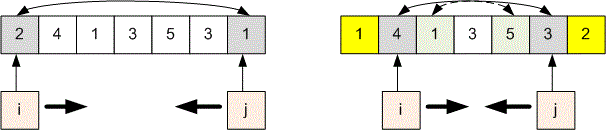
Next, start a while loop, in which:
the values of and are swapped;
then is incremented by , and is decremented by ;
We continue the loop until the pointers and meet.
Note that the values of and can be swapped using an additional variable by performing three operations:

Algorithm implementation
Read the input data.
scanf("%d",&n);
for(i = 0; i < n; i++)
  scanf("%d",&mas[i]);
Print the numbers in the reverse order.
for(i = n - 1; i >= 0; i--)
  printf("%d ",mas[i]);
printf("\n");
Algorithm implementation — reverse the array
Declare an array.
#define MAX 110
int m[MAX];
Read the input data.
scanf("%d",&n);
for(i = 1; i <= n; i++)
  scanf("%d",&m[i]);
Reverse the array using the two-pointer technique.
i = 1; j = n;
while(i < j)
{
  temp = m[i]; m[i] = m[j]; m[j] = temp;
  i++; j--;
}
Print the numbers.
for(i = 1; i <= n; i++)
  printf("%d ",m[i]);
printf("\n");
Algorithm implementation — STL reverse
#include <cstdio>
#include <vector>
#include <algorithm>
using namespace std;

int n, i;
vector<int> mas;

int main(void)
{
  scanf("%d",&n);
  mas.resize(n);
  for(i = 0; i < n; i++)
    scanf("%d",&mas[i]);

  reverse(mas.begin(),mas.end());

  for(i = 0; i < n; i++)
    printf("%d ",mas[i]);
  printf("\n");
  return 0;
}Java implementation — print the array from right to left
import java.util.*;

public class Main
{
  public static void main(String[] args)
  {
    Scanner con = new Scanner(System.in);
    int n = con.nextInt();
    int mas[] = new int[n];
    for(int i = 0; i < n; i++)
      mas[i] = con.nextInt();

    for(int i = n - 1; i >= 0; i--)
      System.out.print(mas[i] + " ");
    System.out.println();
    con.close();
  }
}
Java implementation — reverse
import java.util.*;

public class Main
{
  public static void main(String[] args)
  {
    Scanner con = new Scanner(System.in);
    int n = con.nextInt();
    int m[] = new int[n];

    // Read data
    for(int i = 0; i < n; i++)
      m[i] = con.nextInt();

    // Reverse an array
    int i = 0, j = n - 1;
    while(i < j)
    {
      int temp = m[i]; m[i] = m[j]; m[j] = temp;
      i++; j--;
    }

    // Print the reversed array
    for(i = 0; i < n; i++)
      System.out.print(m[i] + " ");
    System.out.println();
    con.close();
  }
}Python implementation
Read the input data.
n = int(input())
lst = list(map(int, input().split()))
Print the numbers in the reverse order.
for i in range(n - 1,-1,-1):
  print(lst[i], end = " ")
Python implementation — reverse
Read the input data.
n = int(input())
lst = list(map(int, input().split()))
Reverse the list using the reverse function.
lst.reverse()Print the reversed list.
print(*lst)