Connected components#2269

To find the number of connected components in a graph, a disjoint-set data structure (Union-Find) can be used.
Initially, each vertex is placed in its own set, and each vertex is the representative of that set. Then, for each edge , the sets containing vertices and are united. After processing all edges, the number of connected components equals the number of sets in the structure.
This problem can also be solved using depth-first search. In this case, the number of times the dfs procedure is called will equal the number of connected components in the graph.
Example
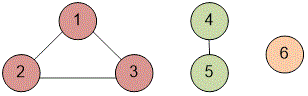
The graph given in the example looks as follows:
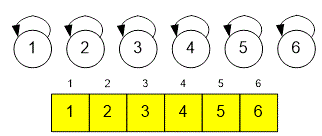
Initially, each vertex is placed in its own set, where it acts as the representative.
Then, for each edge , the sets containing vertices and are united. After processing all edges, two vertices will belong to the same connected component if they have the same representative.
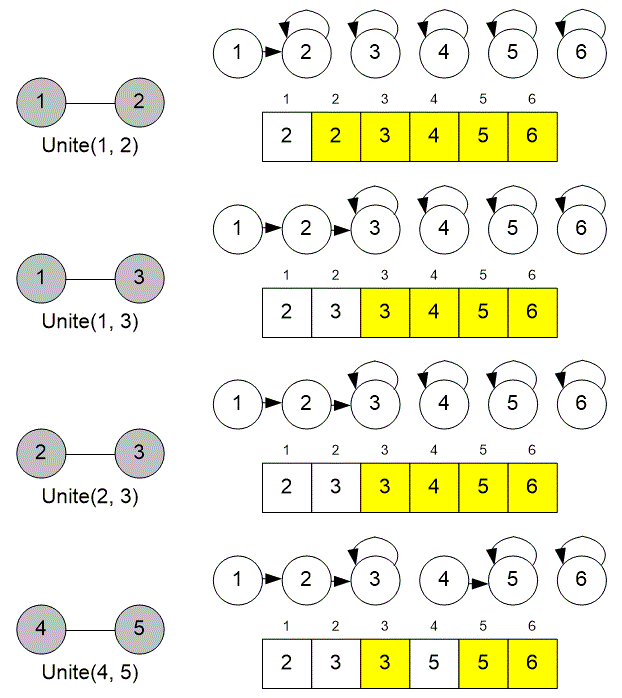
The number of connected components is equal to the number of sets in the disjoint-set structure. This number is determined by the representatives — those vertices for which the condition parent[v] = v holds.
In the given example, the representatives are vertices , and . Therefore, the graph contains three connected components.
Algorithm implementation
stores the maximum number of vertices in the graph. In the array , the number of the vertex to which vertex points is stored.
#define MAX 102
int mas[MAX];
The function Repr returns the representative vertex of the set to which vertex belongs. To do this, we follow the pointers sequentially until we reach the representative of the set (a vertex whose pointer points to itself).
int Repr(int n)
{
  while (n != mas[n]) n = mas[n];
  return n;
}
The Union function merges two sets containing vertices x and y. First, their representatives are found — let them be x_1 and y_1. If x_1 = y_1, then the vertices already belong to the same set, and no further action is required. Otherwise, the pointer of the representative x_1 is redirected to y_1.
void Union(int x,int y)
{
  int x1 = Repr(x),y1 = Repr(y);
  if (x1 == y1) return;
  mas[x1] = y1;
}
The main part of the program. Each vertex initially points to itself (mas[i] = i).
scanf("%d",&n);
for (i = 1; i <= n; i++) mas[i] = i;
Read the adjacency matrix. For each edge where i < j, perform a union of the sets containing vertices and .
for (i = 1; i <= n; i++)
for (j = 1; j <= n; j++)
{
  scanf("%d",&value);
  if (i > j) continue;
  if (value) Union(i,j);
}The variable stores the number of connected components. This number is equal to the number of representative vertices of the sets — that is, those vertices that point to themselves.
count = 0;
for (i = 1; i <= n; i++)
  if (mas[i] == i) count++;
Print the answer.
printf("%d\n",count);Algorithm implementation – depth first search
Declare the arrays.
#define MAX 102
int g[MAX][MAX], used[MAX];
The dfs function performs a depth-first search of the graph, starting from vertex .
void dfs(int v)
{
  used[v] = 1;
  for (int i = 0; i < n; i++)
    if (g[v][i] && !used[i]) dfs(i);
}
The main part of the program. Read the input data.
scanf("%d",&n);
for(i = 0; i < n; i++)
for(j = 0; j < n; j++)
  scanf("%d",&g[i][j]);
The variable stores the number of connected components.
res = 0;A depth-first search is performed on the disconnected graph. Each call to the dfs function starts from an unvisited vertex, so the number of dfs calls equals the number of connected components in the graph.
memset(used,0,sizeof(used));
for (i = 0; i < n; i++)
  if (!used[i])
  {
    dfs(i);
    res++;
}Print the answer.
printf("%d\n",res);Java implementation – dfs
import java.util.*;

public class Main
{
  static int g[][], used[];
  static int n;

  static void dfs(int v)
  {
    used[v] = 1;
    for(int i = 1; i <= n; i++)
      if (g[v][i] == 1 && used[i] == 0) dfs(i);
  }

  public static void main(String[] args)
  {
    Scanner con = new Scanner(System.in);
    n = con.nextInt();
    g = new int[n+1][n+1];
    used = new int[n+1];

    for(int i = 1; i <= n; i++)
    for(int j = 1; j <= n; j++)
      g[i][j] = con.nextInt();;

    int res = 0;
    for(int i = 1; i <= n; i++)
      if (used[i] == 0)
      {
        dfs(i);
        res++;
      }

    System.out.println(res);
    con.close();
  }
}
Java implementation – dsu
import java.util.*;

public class Main
{
  static int mas[];
  static int n;

  static int Repr(int n)
  {
    while (n != mas[n]) n = mas[n];
    return n;
  }

  static void Union(int x,int y)
  {
    int x1 = Repr(x);
    int y1 = Repr(y);
    if (x1 == y1) return;
    mas[x1] = y1;
  }

  public static void main(String[] args)
  {
    Scanner con = new Scanner(System.in);
    n = con.nextInt();
    mas = new int[n+1];
    for(int i = 1; i <= n; i++) mas[i] = i;

    for(int i = 1; i <= n; i++)
    for(int j = 1; j <= n; j++)
    {
      int val = con.nextInt();
      if (i > j) continue;
      if (val == 1) Union(i,j);
    }

    int count = 0;
    for(int i = 1; i <= n; i++)
      if (mas[i] == i) count++;

    System.out.println(count);
    con.close();
  }
} Python implementation – dsu
The function Repr returns the representative vertex of the set to which vertex belongs. To do this, we follow the pointers sequentially until we reach the representative of the set (a vertex whose pointer points to itself).
def Repr(n):
  while (n != mas[n]): n = mas[n]
  return n
The Union function merges two sets containing vertices x and y. First, their representatives are found — let them be x_1 and y_1. If x_1 = y_1, then the vertices already belong to the same set, and no further action is required. Otherwise, the pointer of the representative x_1 is redirected to y_1.
def Union(x, y):
  x1 = Repr(x)
  y1 = Repr(y)
  if (x1 == y1): return
  mas[x1] = y1
The main part of the program. Each vertex initially points to itself (mas[i] = i).
n = int(input())
mas = [int(i) for i in range (n + 1)]
Read the adjacency matrix. For each edge where i < j, perform a union of the sets containing vertices and .
for i in range(1,n + 1):
  lst = [0] + [int(j) for j in input().split()]
  for j in range(1, n + 1):
    if (i < j and lst[j] == 1): Union(i, j)
The variable stores the number of connected components. This number is equal to the number of representative vertices of the sets — that is, those vertices that point to themselves.
res = 0
for i in range(1, n + 1):
  if (mas[i] == i): res += 1
Print the answer.
print(res)Python implementation – dfs
The dfs function performs a depth-first search of the graph, starting from vertex .
def dfs(v):
  used[v] = 1
  for i in range(n):
    if g[v][i] and not used[i]:
      dfs(i)
The main part of the program. Read the input data.
n = int(input())
g = [[0] * n for _ in range(n)]
used = [0] * n
for i in range(n):
  row = list(map(int, input().split()))
  for j in range(n):
g[i][j] = row[j]The variable stores the number of connected components.
res = 0A depth-first search is performed on the disconnected graph. Each call to the dfs function starts from an unvisited vertex, so the number of dfs calls equals the number of connected components in the graph.
for i in range(n):
  if not used[i]:
    dfs(i)
    res += 1
Print the answer.
print(res)