Find a cycle#2270

Perform a series of depth-first searches (DFS) on the graph. For this, start a DFS from each vertex that is not visited yet. Upon entering a vertex, color it gray, and upon exiting, color it black. If during the search we attempt to move to a vertex that is already colored gray, it means a cycle is detected.
To restore the cycle, it is necessary to store the sequence of vertices in the order they are traversed. For example, if the traversal array contains the vertices (2, 6, 3, 5, 4, 3), the desired cycle will be (3, 5, 4).
Example
The graphs given in the problem statement have the following structure:
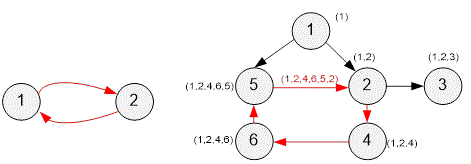
Next to each vertex, the current state of the path array is indicated.
Algorithm implementation
The adjacency list of the graph is stored in the vector . The array stores the sequence of vertices in the order they are traversed during the depth-first search.
vector<vector<int> > g;
vector<int> used, path;
The function dfs implements a depth-first search starting from vertex . Upon entering vertex , color it gray (used[v] = 1), and upon exiting, color it black (used[v] = 2). The global variable indicates the presence of a cycle: flag = 1 means a cycle is found, flag = 0 means there is no cycle.
void dfs(int v)
{
If a cycle is found (flag = 1), there is no point in continuing the search.
if (flag == 1) return;Mark vertex as gray and add it to the array.
  used[v] = 1;
  path.push_back(v);
Iterate over the vertices , adjacent to .
for (int to : g[v])A cycle is considered found if the depth-first search tries to move to a gray vertex (a vertex for which used[to] = 1).
    if (used[to] == 1)
    {
      path.push_back(to);
      flag = 1;
      return;
    }
If vertex is still white, continue the depth-first search from it.
    else
    {
      if (used[to] == 0) dfs(to);
      if (flag == 1) return;
    }
After finishing the processing of vertex , mark it as black. Remove vertex from the array.
  used[v] = 2;
  path.pop_back();
}
The main part of the program. Read the list of edges and build the adjacency list of the graph.
scanf("%d %d", &n, &m);
g.resize(n + 1); used.resize(n + 1, 0);
for(i = 0; i < m; i++)
{
  scanf("%d %d",&a,&b);
  g[a].push_back(b);
}Start a series of depth-first searches. If vertex is not processed yet (used[i] = 0, start a depth-first search from it. If during the execution of the next dfs function call the value of the variable becomes (a cycle is detected in the graph), we stop further searching.
for (i = 1; i <= n; i++)
  if (used[i] == 0)
  {
    dfs(i);
    if (flag == 1) break;
  }
If flag = 1, it means that a cycle is found. In this case, print it based on the information in the array.
if (flag == 1)
{
The cycle is found and ends at vertex cfin = path[path.size() – 1].
cfin = path.back();Move the variable backwards through the array to find the same vertex — the point where the cycle starts.
  cstart = path.size() - 2;
  while (path[cstart] != cfin) cstart--;
Print a message indicating the presence of a cycle and the cycle itself.
  printf("YES\n");
  for (i = cstart; i < path.size() - 1; i++)
    printf("%d ", path[i]);
  printf("\n");
}
Otherwise (flag = 0), there are no cycles in the graph.
else printf("NO\n");Java реализация
import java.util.*;

public class Main
{
  static ArrayList<Integer>[] g;
  static int used[], flag, n, m;
  static Vector<Integer> path = new Vector<Integer>();

  static void dfs(int v)
  {
    if (flag == 1) return;
    used[v] = 1;
    path.add(v);

    for (int i = 0; i < g[v].size(); i++)
    {
      int to = g[v].get(i);
      if (used[to] == 1)
      {
        path.add(to);
        flag = 1;
        return;
      }
      else dfs(to);
      if (flag == 1) return;
    }

    used[v] = 2;
    path.remove(path.size() - 1);
  }

  public static void main(String[] args)
  {
    Scanner con = new Scanner(System.in);
    n = con.nextInt();
    m = con.nextInt();

    g = new ArrayList[n+1];
    for (int i = 0; i <= n; i++)
      g[i] = new ArrayList<Integer>();
    used = new int[n+1];

    for(int i = 0; i < m; i++)
    {
      int a = con.nextInt();
      int b = con.nextInt();
      g[a].add(b);
    }

    for (int i = 1; i <= n; i++)
      if (used[i] == 0)
      {
        dfs(i);
        if (flag == 1) break;
      }

    if (flag == 1)
    {
      int i = path.size() - 2;
      int to = path.lastElement();
      while (path.get(i) != to) i--;

      System.out.println("YES");
      for (; i < path.size() - 1; i++)
        System.out.print(path.get(i) + " ");
      System.out.println();
    }
    else System.out.println("NO");
    con.close();
  }
}