Breadth First Search#2401

Find the shortest path in the graph from vertex to vertex using breadth first search.
Example
The graph given in the example, has the following form:
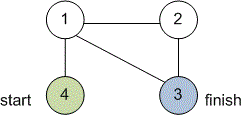
Algorithm implementation
Declare an adjacency matrix to store the graph and an array to store the shortest distances from the source to the vertices.
#define MAX 101
int g[MAX][MAX], dist[MAX];
The bfs function implements a breadth-first search starting from the vertex .
void bfs(int start)
{
Initialize the array. If dist[i] = -1, it means that vertex is not visited.
  memset(dist, -1, sizeof(dist));
  dist[start] = 0;
Dclare and initialize a queue .
  queue<int> q;
  q.push(start);
Continue the breadth-first search as long as the queue is not empty.
  while (!q.empty())
  {
Extract and remove vertex from the front of the queue.
int v = q.front(); q.pop();Where can we go from vertex ? Iterate over the edges v → to.
for (int to = 1; to <= n; to++)If there is an edge from to and vertex is not visited, then move to it (the edge (v, to) becomes an edge of the breadth-first search tree).
      if (g[v][to] && dist[to] == -1)
      {
Add vertex to the end of the queue and compute the shortest distance dist[to].
        q.push(to);
        dist[to] = dist[v] + 1;
      }
  }
}
The main part of the program. Read the input data.
scanf("%d %d %d", &n, &s, &f);
for (i = 1; i <= n; i++)
for (j = 1; j <= n; j++)
  scanf("%d", &g[i][j]);
Start the breadth-first search from vertex .
bfs(s);Print the shortest distance. If there is no path to vertex f~(dist[f] < 0), set dist[f] = 0.
if (dist[f] < 0) dist[f] = 0;
printf("%d\n", dist[f]);
Algorithm implementation — adjacency list
Declare an adjacency list to store the graph and an array to store the shortest distances from the source to the vertices.
vector<vector<int> > g;
vector<int> dist;
The bfs function implements a breadth-first search starting from the vertex .
void bfs(int start)
{
Initialize the array. If dist[i] = -1, it means that vertex is not visited.
  dist = vector<int>(n + 1, -1);
  dist[start] = 0;
Dclare and initialize a queue .
  queue<int> q;
  q.push(start);
Continue the breadth-first search as long as the queue is not empty.
  while (!q.empty())
  {
Extract and remove vertex from the front of the queue.
int v = q.front(); q.pop();Where can we go from vertex ? Iterate over the edges v → to.
for (int to : g[v])If vertex is not visited, then move to it (the edge (v, to) becomes an edge of the breadth-first search tree).
      if (dist[to] == -1)
      {
Add vertex to the end of the queue and compute the shortest distance dist[to].
        q.push(to);
        dist[to] = dist[v] + 1;
      }
  }
}
The main part of the program. Read the input data.
scanf("%d %d %d", &n, &s, &f);
g.resize(n + 1);
for (i = 1; i <= n; i++)
for (j = 1; j <= n; j++)
{
  scanf("%d", &val);
  if (val == 1) g[i].push_back(j);
}Start the breadth-first search from vertex .
bfs(s);Print the shortest distance. If there is no path to vertex f~(dist[f] < 0), set dist[f] = 0.
if (dist[f] < 0) dist[f] = 0;
printf("%d\n", dist[f]);
Java implementation — adjacency matrix
import java.util.*;

public class Main
{
  static int g[][], dist[];
  static int n, s, f;

  static void bfs(int start)
  {
    Arrays.fill(dist,-1);
    dist[start] = 0;

    Queue<Integer> q = new LinkedList<Integer>();
    q.add(start);

    while(!q.isEmpty())
    {
      int v = q.poll();
      for(int to = 1; to <= n; to++)
        if (g[v][to] == 1 && dist[to] == -1)
        {
          q.add(to);
          dist[to] = dist[v] + 1;
        }
    }
  }

  public static void main(String[] args)
  {
    Scanner con = new Scanner(System.in);
    n = con.nextInt();
    s = con.nextInt();
    f = con.nextInt();
    g = new int[n+1][n+1];
    dist = new int[n+1];

    for (int i = 1; i <= n; i++)
    for (int j = 1; j <= n; j++)
      g[i][j] = con.nextInt();

    bfs(s);

    if (dist[f] < 0) dist[f] = 0;
    System.out.println(dist[f]);

    con.close();
  }
}
Java implementation — adjacency list
import java.util.*;

public class Main
{
  static ArrayList<Integer>[] g;
  static int dist[];

  static void bfs(int start)
  {
    Arrays.fill(dist,-1);
    dist[start] = 0;

    Queue<Integer> q = new LinkedList<Integer>();
    q.add(start);

    while(!q.isEmpty())
    {
      int v = q.poll();
      for(int i = 0; i < g[v].size(); i++)
      {
        int to = g[v].get(i);
        if (dist[to] == -1)
        {
          q.add(to);
          dist[to] = dist[v] + 1;
        }
      }
    }
  }

  @SuppressWarnings("unchecked")
  public static void main(String[] args)
  {
    Scanner con = new Scanner(System.in);
    int n = con.nextInt();
    int s = con.nextInt();
    int f = con.nextInt();

    g = new ArrayList[n+1];
    for(int i = 0; i <= n; i++)
      g[i] = new ArrayList<Integer>();

    dist = new int[n+1];

    for (int i = 1; i <= n; i++)
    for (int j = 1; j <= n; j++)
    {
      int val = con.nextInt();
      if (val == 1) g[i].add(j);
    }

    bfs(s);

    if (dist[f] < 0) dist[f] = 0;
    System.out.println(dist[f]);
    con.close();
  }
} Python implementation — adjacency matrix
Import the deque.
from collections import dequeThe bfs function implements a breadth-first search starting from the vertex .
def bfs(start):Initialize the list. If dist[i] = -1, it means that vertex is not visited.
  global dist
  dist = [-1] * (n + 1)
  dist[start] = 0
Declare and initialize a queue .
q = deque([start])Continue the breadth-first search as long as the queue is not empty.
while q:Extract and remove vertex from the front of the queue.
v = q.popleft()Where can we go from vertex ? Iterate over the edges v → to.
for to in range(1, n + 1):If there is an edge from to and vertex is not visited, then move to it (the edge (v, to) becomes an edge of the breadth-first search tree).
if g[v][to] == 1 and dist[to] == -1:Add vertex to the end of the queue and compute the shortest distance dist[to].
        q.append(to)
        dist[to] = dist[v] + 1
The main part of the program. Read the input data.
n, s, f = map(int, input().split())
g = [[] for _ in range(n + 1)]
for i in range(1, n + 1):
  g[i] = [0] + list(map(int, input().split()))
Start the breadth-first search from vertex .
bfs(s)Print the shortest distance. If there is no path to vertex f~(dist[f] < 0), set dist[f] = 0.
if dist[f] < 0: dist[f] = 0
print(dist[f])
Python implementation — adjacency list
Import the deque.
from collections import dequeThe bfs function implements a breadth-first search starting from the vertex .
def bfs(start):Initialize the list. If dist[i] = -1, it means that vertex is not visited.
  global dist
  dist = [-1] * (n + 1)
  dist[start] = 0
Declare and initialize a queue .
q = deque([start])Continue the breadth-first search as long as the queue is not empty.
while q:Extract and remove vertex from the front of the queue.
v = q.popleft()Where can we go from vertex ? Iterate over the edges v → to.
for to in g[v]:If vertex is not visited, then move to it (the edge (v, to) becomes an edge of the breadth-first search tree).
if dist[to] == -1:Add vertex to the end of the queue and compute the shortest distance dist[to].
        q.append(to)
        dist[to] = dist[v] + 1
The main part of the program. Read the input data.
n, s, f = map(int, input().split())Initialize and construct the adjacency list .
g = [[] for _ in range(n + 1)]
for i in range(1, n + 1):
  row = [0] + list(map(int, input().split()))
  for j in range(1, n + 1):
    if row[j] == 1: g[i].append(j)
Start the breadth-first search from vertex .
bfs(s)Print the shortest distance. If there is no path to vertex f~(dist[f] < 0), set dist[f] = 0.
if dist[f] < 0: dist[f] = 0
print(dist[f])