Fibonacci strings#2524

Fibonacci strings are defined recursively:
This means that the string F_n consists of two consecutive parts:
the first F_{n-2} characters form the string F_{n-2},
the next F_{n-1} characters form the string F_{n-1}.
Therefore, to find the -th character of the string F_n, it is not necessary to construct the entire string. It is enough to determine in which of the two parts it lies.
Let F_n(k) denote the -th character of the string F_n.

Then:
if k ≤ |F_{n-2}|, the required character lies in the first part:
otherwise (if k > |F_{n-2}|), the character lies in the second part:
Thus, the problem reduces to finding a character in strings with smaller indices.
Example
Consider the string F_6, for which the following relations hold:
F_6 = F_4 + F_5,
|F_4| = 5, |F_5| = 8
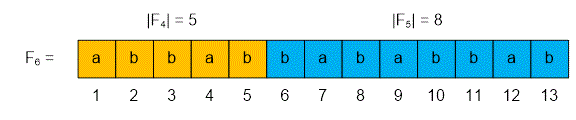
Let us compute F_6(4). Since k = 4 \le |F_4| = 5, we have F_6(4) = F_4(4).
Let us compute F_6(7). Since k = 7 > |F_4| = 5, we have F_6(7) = F_5(7 - 5) = F_5(2).
Algorithm implementation
The array stores the lengths of the Fibonacci strings:
contains the length of the string F_i.
#define MAX 44
int fib[MAX] = {1, 1};
The function solve returns the -th character of the string F_n without constructing the string itself in full.
char solve(int n, int k)
{
The base cases n = 0 and n = 1 are handled separately.
  if (n == 0) return 'a';
  if (n == 1) return 'b';
It is known that F_n = F_{n - 2} + F_{n - 1}.
If k \le F_{n - 2}, then the -th character lies in the string F_{n - 2}.
If k > F_{n - 2}, then the -th character lies in the string F_{n - 1}. However, its position is shifted by the length of the first part, so we look for the character with index k - F_{n - 2}.
  if (k <= fib[n-2]) return solve(n - 2, k);
  return solve(n - 1, k - fib[n-2]);
}
The main part of the program. Compute the first Fibonacci numbers.
for (int i = 2; i < MAX; i++)
  fib[i] = fib[i-1] + fib[i-2];
Read the number of test cases .
scanf("%d",&tests);
while (tests--)
{
Compute and print the answer for each test case.
  scanf("%d %d",&n,&k);
  printf("%c\n",solve(n,k));
}