Triangle#2732

A triangle is one of the basic shapes of geometry: a polygon with three corners or vertices and three sides or edges, which are line segments.
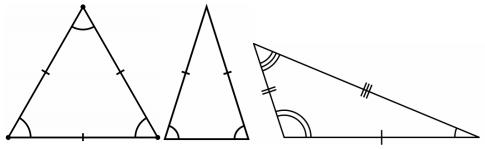
Triangles can be classified according to the relative lengths of their sides:
In an equilateral triangle, all sides have the same length. An equilateral triangle is also a regular polygon, with all angles measuring 60°.
In an isosceles triangle, two sides are equal in length. An isosceles triangle also has two angles of the same measure; namely, the angles opposite the two sides of the same length. This is called the isosceles triangle theorem.
In a scalene triangle, all sides are unequal. The three angles are also all different in measure. Some (but not all) scalene triangles may also be right triangles.
The first line contains an integer (1 \leq T \leq 100), the number of test cases. Each of the following lines contains integers , , and (1 \leq A,B,C \leq 1000000) — the side lengths of a triangle.
For each test case, print "equilateral", "isosceles" or "scalene" describing the triangle type. If the input does not form a valid triangle, output "invalid!". Follow the output format below.
Example 1