Queue#3004

Let's simulate the ticket-selling process using a multiset . First, assign the first people to the available counters and record their service times in the multiset.
During the process, the multiset will always contain elements, each representing the moment when a corresponding counter becomes available to serve the next customer. Clearly, each new person should go to the counter with the earliest available time.
The service time of the last customer will be the desired result.
Example
Let's consider the given example. First, add the first k = 3 elements to the heap.
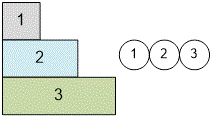
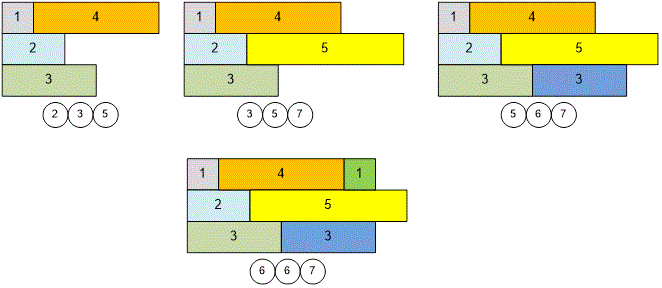
At each iteration, take the next element (the next person in the queue) and place him in the position of the smallest value — at the counter that will become available first. Add to the queue the time when this new person will finish his service at the counter.
Next to each illustration, the numbers in the heap are shown.
Algorithm implementation
Store the timestamps of ticket sales at the counters in the multiset .
multiset<long long> s;Read the input data. The service times of the first k people are added to .
scanf("%d %d",&n,&k);
for(i = 0; i < n; i++)
{
  scanf("%d",&ti);
  if (s.size() != k) s.insert(ti);
  else
{Find the person who will finish his service first and place the next person in line after them.
    long long temp = *s.begin();
    s.erase(s.begin());
    s.insert(temp + ti);
  }
}
The largest number in the multiset represents the moment when the last customer will be served. This is the desired result.
while(s.size() > 1) s.erase(s.begin());
printf("%lld\n",*s.begin());
Algorithm implementation — priority queue
Create a heap, which root contains the smallest element.
priority_queue<long long, vector<long long>, greater<long long> > pq;Read the input data. Put the service time of the first people into the queue .
scanf("%d %d",&n,&k);
for(i = 0; i < n; i++)
{
  scanf("%d",&ti);
  if (pq.size() != k) pq.push(ti);
  else
{Find the person who will finish his service first and place the next person in line after them.
    long long temp = pq.top(); pq.pop();
    pq.push(temp + ti);
  }
}
The largest number in the priority queue represents the moment when the last customer will be served. This is the desired result.
while(pq.size() > 1) pq.pop();
printf("%lld\n",pq.top());
Java implementation
import java.util.*;

public class Main
{
  public static void main(String[] args)
  {
    Scanner con = new Scanner(System.in);
    int n = con.nextInt();
    int k = con.nextInt();
    PriorityQueue<Long> pq = new PriorityQueue<Long>();
    for(int i = 0; i < n; i++)
    {
      long ti = con.nextLong();
      if (pq.size() != k) pq.add(ti);
      else pq.add(pq.poll() + ti);
    }
    while(pq.size() > 1) pq.poll();
    System.out.println(pq.poll());
   }
}