Square#3502

Given a square at [0, 1] \times [0, 1] that has points (P_1, P_2, \ldots, P_N) in the square (you may assume that different points can be at the same position), we can connect the points and the four corners of the square with some line segments so that through these segments any two of the N+4 points can reach each other, directly or indirectly. The graph length is defined as the total length of the line segments. When the positions of points are fixed, there must exist a way of connecting them such that it yields the shortest graph length. We use \mathrm{LEN}(P_1, P_2, \ldots, P_N) to record the graph length using this way of connecting.
In this situation, \mathrm{LEN}(P_1, P_2, \ldots, P_N) is a function of P_1, P_2, \ldots, P_N. When P_1, P_2, \ldots, P_N change their positions, \mathrm{LEN}(P_1, P_2, \ldots, P_N) also changes. It's easy to prove that there exist some P_1', P_2', \ldots, P_N' in the square such that \mathrm{LEN}(P_1', P_2', \ldots, P_N') is at its minimum.
Given the initial positions of points, your task is to find points P_1'', P_2'', \ldots, P_N'' in the square such that |P_1P_1''| + |P_2P_2''| + \cdots + |P_NP_N''| is minimized and \mathrm{LEN}(P_1'', P_2'', \ldots, P_N'') = \mathrm{LEN}(P_1', P_2', \ldots, P_N'). You are requested to output the value of |P_1P_1''| + |P_2P_2''| + \cdots + |P_NP_N''|, where |P_iP_i''| is the distance between P_i and P_i''.
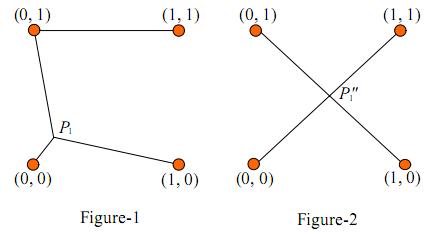
For example, Figure-1 gives the initial position of P_1 and the way of connecting to obtain \mathrm{LEN}(P_1). In Figure-2, it gives the position of P_1'', which is at the center of the square, and the way of connecting to obtain \mathrm{LEN}(P_1''). It can be proved that \mathrm{LEN}(P_1'') = \mathrm{LEN}(P_1'); your job is to output the distance between P_1 and P_1''.
The input consists of several test cases. For each test case, the first line consists of one integer (1 \leq N \leq 100), the number of points, and lines follow to give the coordinates for every point in the following format:
Here, and are floating-point numbers within the range .
A test case with N = 0 indicates the end of input and should not be processed.
For each test case, output the value of |P_1P_1''| + |P_2P_2''| + \cdots + |P_NP_N''|. The value should be rounded to three digits after the decimal point.
Example 1