Vasya and matrix#3535

Let be the input rectangular matrix. Create a two-dimensional array of the same size, where dp[i][j] represents the sum of elements in the submatrix with opposite corners at points and . The values in this array can be computed using the following formula:
Now consider a submatrix of array of size w \times h. Let its opposite corners be located at coordinates and (i + w - 1, j + h - 1).
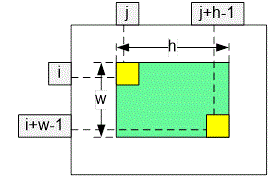
Then the sum of all elements in the submatrix is calculated using the formula:
Let's solve the problem using brute-force search. Iterate over all possible submatrix sizes w \times h, as well as all valid coordinates of the top-left corner of the submatrix. Using the array, compute the sum of elements inside the current submatrix in constant time. If this sum does not exceed , we keep track of the maximum area among all such submatrices.
However, this brute-force approach has a time complexity of O(n^4), which is too slow. We can speed it up to O(n^3logn) by applying binary search on the width of the submatrix.
Fix the top-left corner . Let g(w, h) denote the sum of elements in the submatrix with corners at and (i + w - 1, j + h - 1). If we fix the height and treat the width as a variable, then g(w, h) becomes a non-decreasing function with respect to , since the original matrix contains non-negative integers. This allows us to use binary search to find the maximum value of for which g(w, h) \le k.
Example
For example, the sum of the numbers in the submatrix with corners at points and is
Algorithm implementation
The input matrix is stored in the array .
#define MAX 210
int a[MAX][MAX], dp[MAX][MAX];
The function f(w, h) returns if there exists a submatrix of size w \times h such that the sum of its elements does not exceed . To check this, all possible coordinates of the top-left corner are iterated over, and the sum of elements in the rectangle with corners at and (i + w - 1, j + h - 1) is computed in constant time using the array.
int f(int w, int h)
{
  for (int i = 1; i + w - 1 <= n; i ++)
  for (int j = 1; j + h - 1 <= m; j ++)
    if (dp[i + w - 1][j + h - 1] - dp[i + w - 1][j - 1] –
        dp[i - 1][j + h - 1] + dp[i - 1][j - 1] <= k) return 1;
  return 0;
};The main part of the program. Read the input matrix.
scanf("%d %d %d",&n,&m,&k);
for (i = 1; i <= n; i++)
for (j = 1; j <= m; j++)
  scanf("%d",&a[i][j]);
Based on the input matrix , compute the auxiliary matrix .
for (i = 1; i <= n; i++)
for (j = 1; j <= m; j++)
  dp[i][j] = dp[i - 1][j] + dp[i][j - 1] - dp[i - 1][j - 1] + a[i][j];
Iterate over the possible values of the submatrix width .
answer = 0;
for (w = 1; w <= n; w++)
{
The length of the submatrix is determined using binary search over the range [l; r].
  l = 1; r = m;
  while (l < r)
  {
    mid = (l + r) / 2;
For a submatrix of size w \times mid, iterate over all possible positions of its top-left corner . If there exists at least one position where the sum of elements in the submatrix does not exceed , update the value of the resulting area .
    if (f(w,mid))
    {
      answer = max(answer, w * mid);
      l = mid + 1;
    }
    else r = mid;
  }

  mid = (l + r) / 2;
  if (f(w,mid))
    answer = max(answer, w * mid);
};Print the area of the largest submatrix found.
printf("%d\n",answer);