Bitris#3842

There is a set of 2 \times N cubes. Each cube has an integer ranging from to assigned to it, labeling each of the cube's sides. Each number is written on exactly two cubes. Cubes are placed one on top of another, in a pile. If two cubes with the same number stand next to each other, they annihilate: both cubes disappear, and cubes standing above come down to fill the space.
Your task is to disassemble the pile – eliminate all cubes. You are allowed to swap any two neighboring cubes. A swap could be done only after all possible annihilations are done.
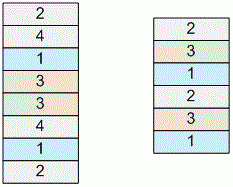
For example, if N = 4 and cubes are standing as you see on the left then you need to make one swap. Cubes with label annihilate immediately; you swap the fourth bottom cube (with label ) and the fifth bottom cube (with label ); afterwards, cubes with labels annihilate, followed by cubes with labels and labels . Other option is to swap third and fourth bottom cubes (in this case cubes with labels and annihilate at same time, followed by cubes with label ), or second and third.
If N = 3, and cubes are standing like shown on the right, you need to perform swaps. One way to solve is to swap fifth and sixth cubes, then fourth and fifth; cubes with labels annihilate; then swap second and third; other cubes annihilate simultaneously.
The task is to find the minimal number of swaps, such that all cubes are eliminated.
The first line contains the positive integer (2 \leq N \leq 100000). The second line contains the labels of all cubes, bottom up, split by spaces.
Print the minimal number of swaps necessary to destroy all cubes.
Мысал 1
Мысал 2
Мысал 3