From adjacency matrix to adjacency list#3981

Read the adjacency matrix and build the adjacency list from it. Then, print the list.
Example
The graph from the example has the following form.
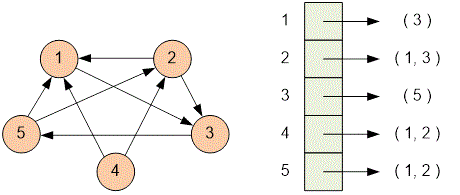
Algorithm implementation
Declare the adjacency list of the graph.
vector<vector<int> > g;Read the input data. The vertices of the graph are numbered from to . Build the adjacency list.
scanf("%d", &n);
g.resize(n + 1);
for (i = 1; i <= n; i++)
for (j = 1; j <= n; j++)
{
  scanf("%d", &val);
  if (val) g[i].push_back(j);
}Print the adjacency list.
for (i = 1; i <= n; i++)
{
  printf("%d", g[i].size());
  for (int x : g[i])
    printf(" %d", x);
  printf("\n");
}Java implementation — array of ArrayList
import java.util.*;

public class Main
{
  public static void main(String[] args)
  {
    Scanner con = new Scanner(System.in);

    int n = con.nextInt();
    ArrayList<Integer>[] g = new ArrayList[n+1]; // unchecked
    for (int i = 0; i <= n; i++)
      g[i] = new ArrayList<Integer>();

    for (int i = 1; i <= n; i++)
    for (int j = 1; j <= n; j++)
    {
      int val = con.nextInt();
      if (val == 1) g[i].add(j);
    }

    for (int i = 1; i <= n; i++)
    {
      System.out.print(g[i].size());
      for (int j = 0; j < g[i].size(); j++)
        System.out.print(" " + g[i].get(j));
      System.out.println();
    }
    con.close();
  }
}
Java implementation — ArrayList of ArrayList
import java.util.*;
import java.io.*;

public class Main
{
  public static void main(String[] args)  throws IOException
  {
    //Scanner con = new Scanner(new FileReader ("3981.in"));
    Scanner con = new Scanner(System.in);

    int n = con.nextInt();
    ArrayList<ArrayList<Integer>> g =
      new ArrayList<ArrayList<Integer>>();
    for (int i = 0; i <= n; i++)
      g.add(new ArrayList<Integer>());

    for (int i = 1; i <= n; i++)
    for (int j = 1; j <= n; j++)
    {
      int val = con.nextInt();
      if (val == 1) g.get(i).add(j);
    }

    //System.out.println(g);

    for (int i = 1; i <= n; i++)
    {
      System.out.print(g.get(i).size());
      for (int j = 0; j < g.get(i).size(); j++)
        System.out.print(" " + g.get(i).get(j));
      System.out.println();
    }
    con.close();
  }
}Python implementation
Read the number of vertices . Declare the adjacency list .
n = int(input())
g = [[] for _ in range(n + 1)]
Read the adjacency matrix and build the adjacency list. The vertices of the graph are numbered from to .
for i in range(1, n + 1):
  row = list(map(int, input().split()))
  for j in range(1, n + 1):
    if row[j - 1]:
      g[i].append(j)
Print the adjacency list.
for i in range(1, n + 1):
  print(len(g[i]), *g[i])