Staircase Patterns#4073

The numbers written on the steps are integers and fall within the range from to 10^6 inclusive.
We will construct a Fenwick tree on an array of length 10^6 + 1 (with indices ranging from to 10^6 inclusive), initially filled with zeros.
Each time the detective steps on a stair with the value , we increase a_{value} by . At the same time, he records the sum in his notebook:
Given the input constraints, all calculations should be performed using a -bit integer type.
Example
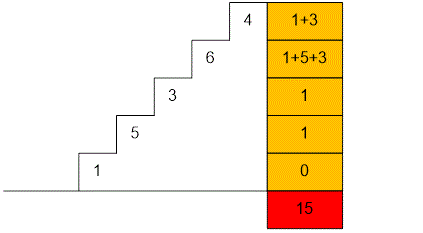
Let's simulate the detective's recordings using the given example. The array indexing starts from . The numbers recorded by the detective are shown under the arrows.
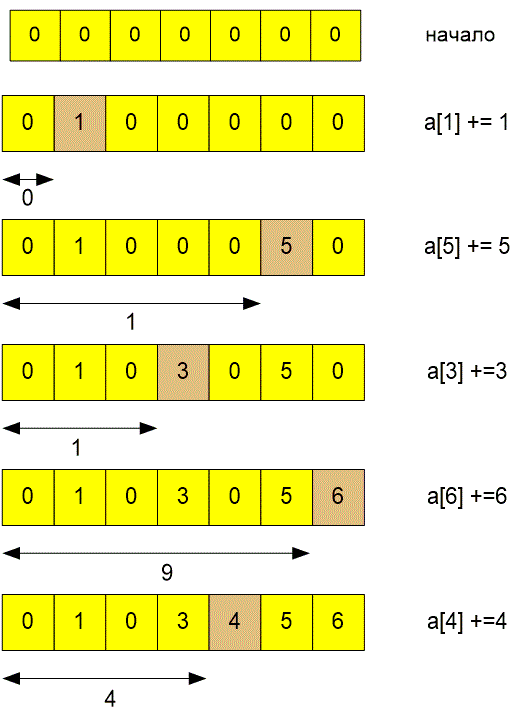
The sum of the numbers written in the detective's notebook is
Algorithm implementation
Let the maximum array size be . Create a Fenwick tree Fenwick.
#define MAX 1000001
vector<long long> Fenwick;
The function Summa0_i computes the sum a_0 + a_1 + ... + a_i.
long long Summma0_i(int i)
{
  long long result = 0;
  for (; i >= 0; i = (i & (i + 1)) - 1)
    result += Fenwick[i];
  return result;
}The function IncElement increases the value of an element: a_i = a_i + delta.
void IncElement(int i, int delta)
{
  for (; i < MAX; i = (i | (i+1)))
    Fenwick[i] += delta;
}
The main part of the program. Read the input data.
scanf("%d",&tests);
while (tests--)
{
  scanf("%d",&n);
Initialize the Fenwick array with zeros.
Fenwick.assign(MAX,0);The desired sum recorded in the detective's notebook will be computed in the variable .
sum = 0;Process the numbers written on the steps one by one.
  for (i = 0; i < n; i++)
  {
For each , written on a step, increase a_{value} by and compute the sum of all previously encountered numbers smaller than . This sum is a_0 + a_1 + a_2 + ... + a_{value - 1}.
    scanf("%d",&value);
    IncElement(value, value);
    sum += Summma0_i(value - 1);
  }
Print the total sum of all numbers written in the detective's notebook.
  printf("%lld\n",sum);
}