Subsets generation#4106

The task is to generate all subsets of a given set. To do this, iterate through all numbers from to 2^n - 1. Represent the number in binary and consider its last bits (which may include leading zeros). Each such binary representation corresponds to a subset: if the -th bit is set to , then the number k~(1 \le k \le n) is included in the subset. For example:
if n = 3 and i = 2, the binary representation of i = 010_2 corresponds to the subset .
if n = 4 and i = 11, the binary representation of i = 1011_2 corresponds to the subset \{1, 2, 4\}.
Example
Let’s consider the generation of subsets for n = 3.
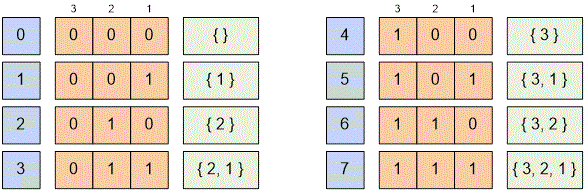
Algorithm implementation
We'll generate subsets as numbers stored in the array . For example, the subset \{1, 2, 3\} will be represented as the number .
#define MAX 8
int v[1 << MAX];
Read the input value .
scanf("%d",&n);In a loop, iterate through all possible masks for subsets of a set with elements. The operation 1 << n shifts the number to the left by positions, which is equivalent to raising to the power of . Generate all 2^n - 1 subsets (excluding the empty one).
for (i = 1; i < (1 << n); i++)
{
Store the elements of the current subset in the variable as a string. For example, the subset \{1, 2, 4\} will be stored as x = 124.
  x = 0;
  for (j = 0; j < n; j++)
    if (i & (1 << j)) x = x * 10 + j + 1;
  v[i] = x;
}
Sort the subsets in ascending order based on their corresponding numbers.
sort(v, v + (1 << n));Print the subsets in the required order.
for (i = 1; i < 1 << n; i++)
  printf("%d\n", v[i]);
Java implementation
import java.util.*;

public class Main
{
  public static void main(String []args)
  {
    Scanner con = new Scanner(System.in);
    int n = con.nextInt();
    int v[] = new int[1<<n];

    for(int i = 1; i < (1 << n); i++)
    {
      int val, j;
      for(val = j = 0; j < n; j++)
        if ((i & (1 << j)) > 0) val = val * 10 + j + 1;
      v[i] = val;
    }

    Arrays.sort(v);
    for(int i = 1; i < 1 << n; i++)
      System.out.println(v[i]);
    con.close();
  }
}