Arson#4369

There is an ordinary spider web in front of you. However, as an experienced competitive programmer, you immediately notice that it represents a connected graph with vertices and edges. If some vertex is set on fire, it ignites immediately; after one second, all vertices adjacent to it will catch fire, then the vertices adjacent to the already burning ones, and so on.
You are given the vertices of the web where the fire starts simultaneously. Determine how many seconds will pass until the last vertex catches fire and also find the number of that vertex.
The first line contains two positive integers n~(1 \le n \le 10^5) and m~(n - 1 \le m \le 10^5) — the number of vertices and the number of edges, respectively.
The next lines contain pairs of integers and v~(1 \le u, v \le n) denoting vertices connected by an edge.
The next line contains an integer k~(1 \le k \le n) — the number of ignition points.
The last line contains integers — the indices of the vertices where the fire starts simultaneously.
In the first line, print the time (in seconds) when the last vertex catches fire. In the second line, print the number of that vertex. If there are multiple such vertices, print the one with the smallest index.
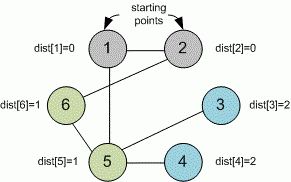
Example 1