Fibonacci#4730

Compute all Fibonacci numbers and store them in the array by assigning fib[i] = f(i). Then print the desired Fibonacci number.
Example
The array will be filled as follows:

Algorithm implementation
Compute the Fibonacci numbers and store them in the array: fib[i] = f(i).
#define MAX 46
int fib[MAX];
Fill the array according to the recursive formula.
fib[0] = 1; fib[1] = 1;
for (int i = 2; i < MAX; i++)
  fib[i] = fib[i-1] + fib[i-2];
Read the input value of . Print the answer.
scanf("%d",&n);
printf("%d\n",fib[n]);
Algorithm implementation — recursion
Declare the array to store Fibonacci numbers: fib[i] = f(i).
#define MAX 46
int fib[MAX];
The recursive function f computes the -th Fibonacci number. The memoization technique is used.
int f(int n)
{
  if (n <= 1) return 1;
  if (fib[n] != -1) return fib[n];
  return fib[n] = f(n-1) + f(n - 2);
}
The main part of the program. Read the value of .
scanf("%d",&n);Assign the value of to all elements of array.
memset(fib,-1,sizeof(fib));Compute and print the value .
printf("%d\n",f(n));Algorithm implementation — iteration
Read the input number .
scanf("%d", &n);Handle the base case.
if (n == 0 || n == 1)
{
  printf("1\n");
  return 0;
}
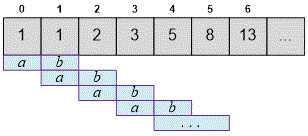
Let us assign:
the -th Fibonacci number to the variable ;
the -st Fibonacci number to the variable ;
Initially, the variables and contain two consecutive Fibonacci numbers.
a = b = 1;
for (i = 2; i <= n; i++)
{
The variables and contain two consecutive Fibonacci numbers.
Compute the next Fibonacci number:
c = a + b;Perform a shift, as a result of which a = f(i - 1) and b = f(i).
  a = b;
  b = c;
}
Print the answer. The variable contains the value of .
printf("%lld\n", b);Java implementation
import java.util.*;

public class Main
{
  public static int MAX = 46;
  static int fib[] = new int[MAX];

  public static void main(String[] args)
  {
    Scanner con = new Scanner(System.in);
    int n = con.nextInt();
    fib[0] = 1; fib[1] = 1;
    for(int i = 2; i < MAX; i++)
      fib[i] = fib[i-1] + fib[i-2];
    System.out.println(fib[n]);
    con.close();
  }
}
Java implementation — constant memory
import java.util.*;

public class Main
{
  public static void main(String[] args)
  {
    Scanner con = new Scanner(System.in);
    int n = con.nextInt();
    int a = 1, b = 1, temp;
    for(int i = 0; i < n; i++)
    {
      temp = a;
      a = b;
      b = temp + b;
    }
    System.out.println(a);
    con.close();
  }
}
Java implementation — recursion with memoization
import java.util.*;

public class Main
{
  static int fib[] = new int[46];

  static int f(int n)
  {
    if (n <= 1) return 1;
    if (fib[n] != -1) return fib[n];
    return fib[n] = f(n-1) + f(n - 2);
  }

  public static void main(String[] args)
  {
    Scanner con = new Scanner(System.in);
    int n = con.nextInt();
    Arrays.fill(fib, -1);
    System.out.println(f(n));
    con.close();
  }
}Python implementation — list
To store Fibonacci numbers, declare a list : fib[i] = f(i).
fib = [1,1]Fill the array according to the recursive formula.
for i in range(2,46):
  fib.append(fib[i-1] + fib[i-2])
The main part of the program. Read the value of .
n = int(input())Compute and print the value .
print(fib[n])Python implementation — constant memory
n = int(input())
a, b = 1, 1
for i in range(n):
  a, b = b, a + b
print(a)
Python implementation — memoization
To store Fibonacci numbers, declare a list : fib[i] = f(i).
fib = [-1] * 46The recursive function f computes the -th Fibonacci number. The memoization technique is used.
def f(n):
  if n <= 1: return 1
  if fib[n] != -1: return fib[n]
  fib[n] = f(n - 1) + f(n - 2)
  return fib[n]
The main part of the program. Read the value of .
n = int(input())Compute and print the value .
print(f(n))