Diagonals#4751

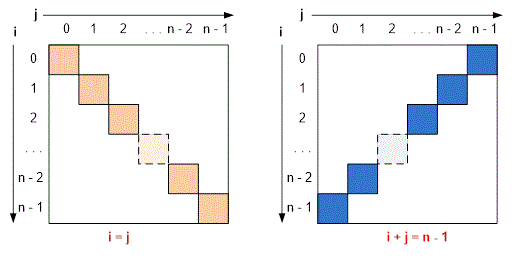
Let be a given two-dimensional array with zero-based indexing. The element belongs to:
the main diagonal if i = j;
the secondary diagonal if i + j = n - 1;
Example
Let’s consider the given example.
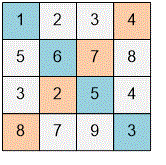
The sum of the integers on the main diagonal is 1 + 6 + 5 + 3 = 15.
The sum of the integers on the secondary diagonal is 8 + 2 + 7 + 4 = 21.
Algorithm implementation
Read the input data. The matrix elements are processed on the fly, without creating a two-dimensional array beforehand.
scanf("%d",&n);
a = b = 0;
for(i = 0; i < n; i++)
for(j = 0; j < n; j++)
{
  scanf("%d",&val);
In the variable , compute the sum of the elements on the main diagonal.
In the variable , compute the sum of the elements on the secondary diagonal.
  if (i == j) a += val;
  if (i + j == n - 1) b += val;
}
Print the answer.
printf("%d %d\n",a,b);Algorithm implementation — two-dimensional array
Declare a two-dimensional array.
int m[510][510];Read the input data.
scanf("%d", &n);
for (i = 0; i < n; i++)
for (j = 0; j < n; j++)
  scanf("%d", &m[i][j]);
In the variable , compute the sum of the elements on the main diagonal.
In the variable , compute the sum of the elements on the secondary diagonal.
a = b = 0;Iterate through all the elements of the two-dimensional array.
for (i = 0; i < n; i++)
for (j = 0; j < n; j++)
{
The element is on the main diagonal if i = j;
if (i == j) a += m[i][j];The element is on the secondary diagonal if i + j = n - 1;
  if (i + j == n - 1) b += m[i][j];
}
Print the answer.
printf("%d %d\n", a, b);Java implementation
import java.util.*;

public class Main
{
  public static void main(String[] args)
  {
    Scanner con = new Scanner(System.in);
    int n = con.nextInt();
    int m[][] = new int[n][n];

    for(int i = 0; i < n; i++)
    for(int j = 0; j < n; j++)
      m[i][j] = con.nextInt();

    int a = 0, b = 0;
    for(int i = 0; i < n; i++)
    for(int j = 0; j < n; j++)
    {
      if (i == j) a += m[i][j];
      if (i + j == n - 1) b += m[i][j];
    }

    System.out.println(a + " " + b);
    con.close();
  }
}
Java implementation — on the fly
import java.util.*;

public class Main
{
  public static void main(String[] args)
  {
    Scanner con = new Scanner(System.in);
    int n = con.nextInt();

    int a = 0, b = 0;
    for(int i = 0; i < n; i++)
    for(int j = 0; j < n; j++)
    {
      int val = con.nextInt();
      if (i == j) a += val;
      if (i + j == n - 1) b += val;
    }

    System.out.println(a + " " + b);
    con.close();
  }
}Python implementation
Read the input data.
n = int(input())
m = [list(map(int, input().split())) for _ in range(n)]
In the variable , compute the sum of the elements on the main diagonal.
In the variable , compute the sum of the elements on the secondary diagonal.
a = b = 0Iterate through all the elements of the two-dimensional array.
for i in range(n):
  for j in range(n):
The element is on the main diagonal if i = j;
if i == j: a += m[i][j]The element is on the secondary diagonal if i + j = n - 1;
if i + j == n - 1: b += m[i][j]Print the answer.
print(a, b)Python implementation — list comprehension
Read the input data.
n = int(input())
m = [list(map(int, input().split())) for _ in range(n)]
In the variable , compute the sum of the elements on the main diagonal.
In the variable , compute the sum of the elements on the secondary diagonal.
a = sum(m[i][i] for i in range(n))
b = sum(m[i][n - 1 - i] for i in range(n))
Print the answer.
print(a, b)