Number of pendant vertices 1#5080

For each vertex , count the number of vertices adjacent to it. If this number equals , then vertex is a pendant vertex.
Example
The graphs shown in the examples have the following form:
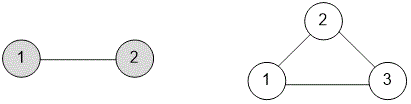
In the first example, the graph contains two vertices of degree . Therefore, it has two pendant vertices.
In the second example, there are no vertices of degree (i.e., no pendant vertices).
Algorithm implementation
Declare an array , where is the number of vertices adjacent to vertex .
#define MAX 1010
int m[MAX];
Read the adjacency matrix of an undirected graph. For each edge , increase the value of by (the value of will also be increased by when the edge is processed).
scanf("%d",&n);
memset(m,0,sizeof(m));
for (i = 0; i < n; i++)
for (j = 0; j < n; j++)
{
  scanf("%d",&val);
  if (val) m[i]++;
}If m[i] = 1, then vertex is connected to exactly one vertex, i.e., it is a pendant vertex. Count the number of such vertices and store the result in the variable .
res = 0;
for (i = 0; i < n; i++)
  if (m[i] == 1) res++;
Print the answer.
printf("%d\n",res);