Implement a stack#5087

In this problem, you need to simulate stack operations.
Example
Consider the stack operations in the first example:
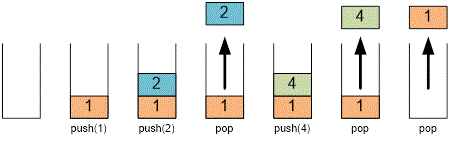
Algorithm implementation
Declare the stack.
stack<int> s;Read the number of operations .
scanf("%d", &n);Sequentially process operations.
for (int i = 0; i < n; i++)
{
  scanf("%d", &op);
Insert the element, push operation.
  if (op == 1)
  {
    scanf("%d", &x);
    s.push(x);
  }
Remove the element, pop operation.
  else
  {
    printf("%d\n", s.top());
    s.pop();
  }
}
Java implementation
import java.util.*;

public class Main
{
  public static void main(String[] args)
  {
    Scanner con = new Scanner(System.in);
    Stack<Integer> s = new Stack<Integer>();
    int n = con.nextInt();
    for (int i = 0; i < n; i++)
    {
      int op = con.nextInt();
      if (op == 1)
      {
        int x = con.nextInt();
        s.push(x);
      }
      else
        System.out.println(s.pop());
    }
    con.close();
  }
}
Java implementation — class MyStack
import java.util.*;

class MyStack
{
  private Vector<Integer> v;

  MyStack()
  {
    v = new Vector<Integer>();
  }

  public void push(int x)
  {
    v.add(x);
  }

  public int pop()
  {
    int last = v.lastElement();
    v.remove(v.size() - 1);
    return last;
  }
}

public class Main
{
  public static void main(String[] args)
  {
    Scanner con = new Scanner(System.in);
    MyStack s = new MyStack();
    int n = con.nextInt();
    for (int i = 0; i < n; i++)
    {
      int op = con.nextInt();
      if (op == 1)
      {
        int x = con.nextInt();
        s.push(x);
      }
      else
        System.out.println(s.pop());
    }
    con.close();
  }
} Python implementation
Read the number of operations .
n = int(input())Use the list to simulate the stack.
stack = []Sequentially process operations.
for i in range(n):
  lst = list(map(int,input().split()))
Insert the element, push operation.
  if (lst[0] == 1):
    stack.append(lst[1])
Remove the element, pop operation.
  else:
    print(stack.pop())